
Rubber Fender Compliance: CCS, BV, ABS, RS & EN 10204 3.1
Rubber Fender Compliance: CCS, BV, ABS, RS & EN 10204 3.1
Rubber fender compliance is the documented evidence that a fender system meets the project's quality, material, testing and traceability requirements. For port and ship projects, the compliance file usually combines ISO 9001 quality-system records, classification-society requirements such as CCS, BV, ABS, RS or LR, PIANC and ISO technical references, EN 10204 3.1 mill test certificates for metal parts and bolts, third-party inspection by agencies such as SGS, BV and LR, and a Quality Inspection Report (QIR) issued before shipment.
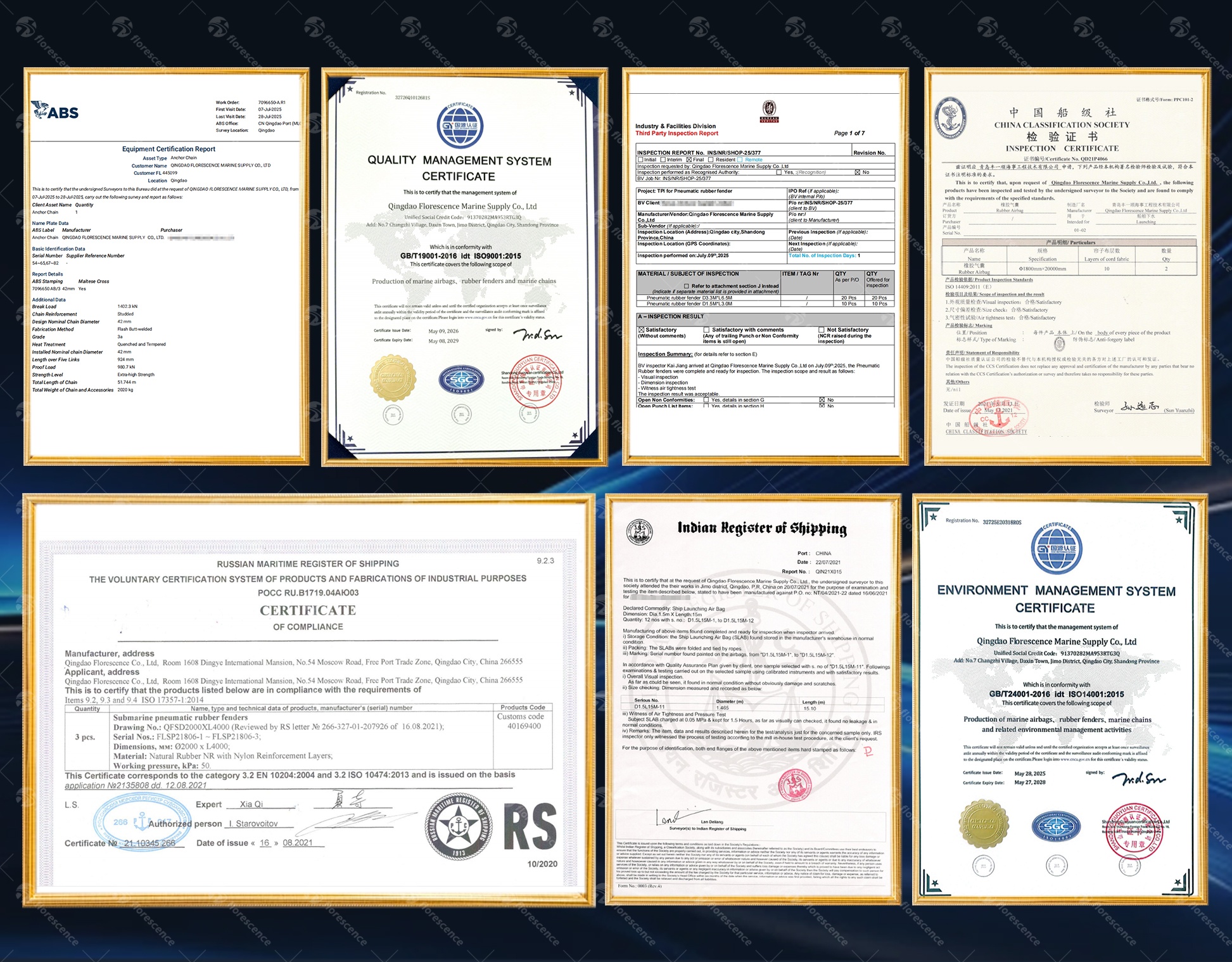
Cover: certificate and inspection documents are part of the rubber fender compliance file.
Problem Definition: Why a Single Certificate Is Not Enough
A rubber fender purchase can look compliant on paper while still leaving the buyer unable to answer basic questions. Which product does the certificate cover? Is it a quality-system certificate, a product test report, a material certificate, or an inspection release? Was the certificate issued for the factory, for a specific batch, or for a project? Without a clear document map, the buyer may receive a file that looks official but does not prove the required traceability.
The practical problem is that fender compliance is a chain, not a single PDF. The chain normally starts with the supplier's quality management system, continues through product-specific standards and classification-society requirements, and ends with pre-shipment inspection records. For metal parts and bolts, the chain often depends on EN 10204 3.1 mill test certificates. For rubber components, it depends on batch testing, dimensional checks and performance records. For the finished fender system, it depends on a QIR that brings the evidence together before shipping.
Buyers in the awareness and research stage do not need a sales promise. They need to know which documents exist, who issues them, what they cover, and how to verify them in an RFQ. That is the purpose of this guide.
Industry Background: Compliance Is Project-Specific
Marine fenders protect vessel hulls and berthing facilities during berthing. Because they are safety-related components, port authorities, shipyards, naval organizations and engineering contractors often apply project-specific documentation requirements. A supplier may be able to manufacture and inspect products according to the applicable requirements of recognized marine classification societies, including CCS, BV, RS, ABS and LR, based on specific project requirements. That wording matters: classification-society involvement is usually defined by the project, not assumed for every order.
Rubber fender standards also differ by product type. Arch fenders and cell fenders are commonly described with reference to PIANC guidance. Pneumatic rubber fenders are associated with ISO 17357-1:2014, which specifies requirements for high-pressure floating pneumatic rubber fenders. A buyer should therefore match the standard to the fender technology, not apply one certificate template to every product.
Quality-system certification is the foundation that supports consistent production and inspection. Qingdao Florescence Marine Supply Co., Ltd., founded in 1992, states that its products are designed, manufactured and tested in accordance with ISO 9001:2015 quality management requirements. The company operates a 40,000 m² manufacturing facility with approximately 120 staff and annual output of about 2,000 pcs of marine rubber fenders and airbags. These facts are relevant because a compliance file is only credible when it is supported by a working quality system, not by isolated paperwork.
Detailed Solution: Building a Rubber Fender Compliance File
1. ISO 9001:2015 as the Quality-System Foundation
ISO 9001 is a quality management system standard. In a fender project, it supports controlled production, inspection and document handling. The supplier's ISO 9001 certificate should be checked for scope, validity and the legal entity that holds it. The certificate should cover the actual manufacturing activity, not only a trading office. Florescence states that its factory is ISO 9001 certified and that products are designed, manufactured and tested in accordance with ISO 9001:2015 quality management requirements.
For the buyer, the ISO 9001 certificate is a starting point. It does not replace product testing, material traceability or project inspection. It tells the buyer that a quality system exists. The next step is to verify that the system covers the specific fender type and the required inspection records.
2. Classification Societies: CCS, BV, ABS, RS and LR
Classification-society requirements are often written into port, shipyard or naval specifications. Florescence states that products can be manufactured and inspected according to applicable requirements of recognized marine classification societies, including CCS, BV, RS, ABS and LR, based on specific project requirements. This means the buyer should confirm the exact society, the scope of involvement, the inspection stage and the document to be issued before production begins.
The same principle applies to product specification sheets, which list CCS, BV, ISO, RS and ABS among available certification references for certain fender products. A buyer should not read that list as a blanket claim that every product carries every certificate. The correct reading is that certification references are available and should be selected according to the project's technical specification.
For pneumatic fenders, ISO 17357-1:2014 is the relevant international standard for high-pressure floating pneumatic rubber fenders. For arch and cell fenders, PIANC guidance is commonly referenced. A compliance file should show which standard was applied to which product, and which inspection body witnessed the relevant tests.
3. PIANC and ISO References: Match the Standard to the Product
PIANC guidelines are widely used in fender design and testing discussions. Florescence states that its marine fender systems are manufactured and tested in accordance with PIANC guidelines and global engineering standards. Arch fenders are described as manufactured in accordance with the PIANC standard. Cell fenders are described as conforming to PIANC standards and, in the product description, to ISO17357. Pneumatic rubber fenders are associated with ISO 17357-1:2014.
The buyer's task is to avoid a generic statement such as 'PIANC compliant' without a product link. Ask for the product type, the design basis, the test method and the document that records the result. A useful compliance file will connect the standard to the actual fender model, size and project application.
4. EN 10204 3.1 Mill Test Certificates for Metal Parts and Bolts
Rubber fenders often include metal components such as frontal panels, brackets, chains, shackles and anchor bolts. These parts are exposed to marine corrosion and structural load. For this reason, buyers frequently request EN 10204 3.1 mill test certificates for metal parts and bolts. Florescence states that full traceability is guaranteed and that EN 10204 3.1 Mill Test Certificates are provided for all metal parts and bolts.
An EN 10204 3.1 mill test certificate is a material traceability document linked to the specific metal batch or heat. It allows the buyer to connect the delivered component to the recorded material test result. In a fender package, the buyer should confirm which metal items are covered, whether the certificate matches the delivered batch, and whether the certificate is included in the final QIR.
Corrosion protection also needs records. Florescence states that digital gauges are used to measure the marine epoxy coating thickness on steel components to ensure it meets target microns and prevents paint peeling in sea water. Dimensional checks are also performed on custom accessories, including hole patterns on UHMW-PE pads and the pitch of anchor bolts, to support on-site assembly. These checks are part of the practical compliance file because they connect the certificate to the delivered hardware.
5. Third-Party Inspection by SGS, BV and LR
Third-party inspection gives the buyer independent evidence that the product and documents match the order. Florescence states that it welcomes third-party inspection and frequently works with international agencies such as SGS, Bureau Veritas (BV) and LR to inspect marine fenders and steel structures. The factory cooperates fully with the buyer's chosen inspector.
The inspection plan should be agreed before production. It should define the inspection agency, the witness points, the tests to be observed, the documents to be reviewed and the release condition. For example, a buyer may request BV inspection of pneumatic fenders before shipment. The image below shows a BV inspection of D2.5 m x L5.5 m pneumatic fenders.
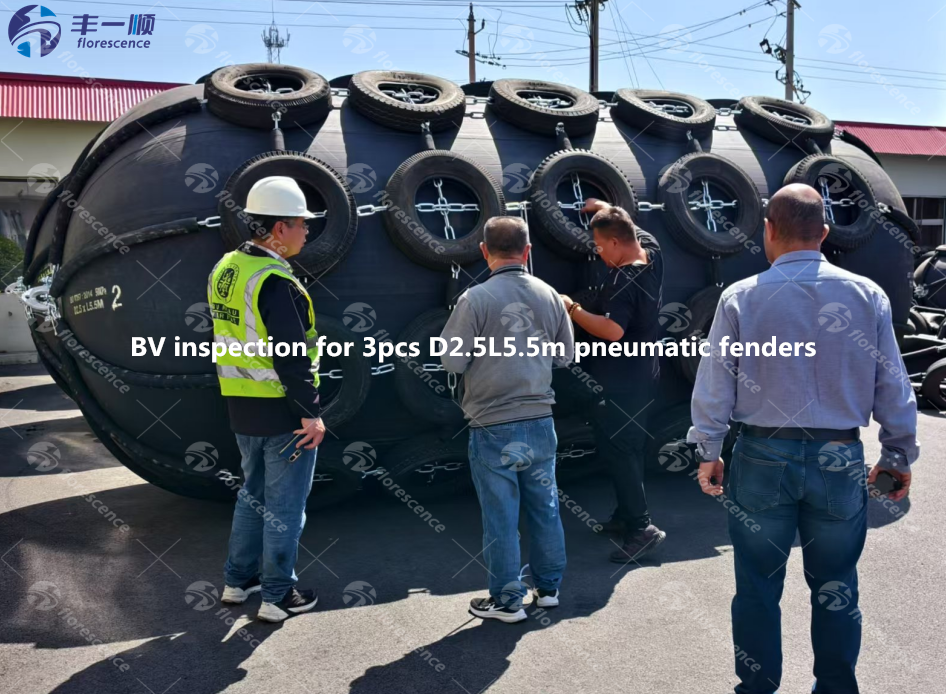
Body: BV third-party inspection for three D2.5 m x L5.5 m pneumatic fenders.
Third-party inspection does not replace the supplier's own quality control. It adds an independent layer. The buyer should ensure that the inspection report is issued before shipment and that any open findings are closed before the QIR is approved.
6. The Quality Inspection Report (QIR) Before Shipping
Florescence states that a full Quality Inspection Report (QIR) is sent before shipping. The QIR includes rubber test data, sizing sheets, coating thickness records and clear product photos. The company states that it ships only after the buyer's approval.
The QIR is the practical document that lets the buyer review the order before release. It should be read as a package, not as a single attachment. The rubber test data addresses material and physical properties. The sizing sheets address dimensions. The coating thickness records address corrosion protection. The product photos confirm identification and visible condition. For metal parts and bolts, the EN 10204 3.1 mill test certificates should be cross-checked against the packing list and the delivered batch.
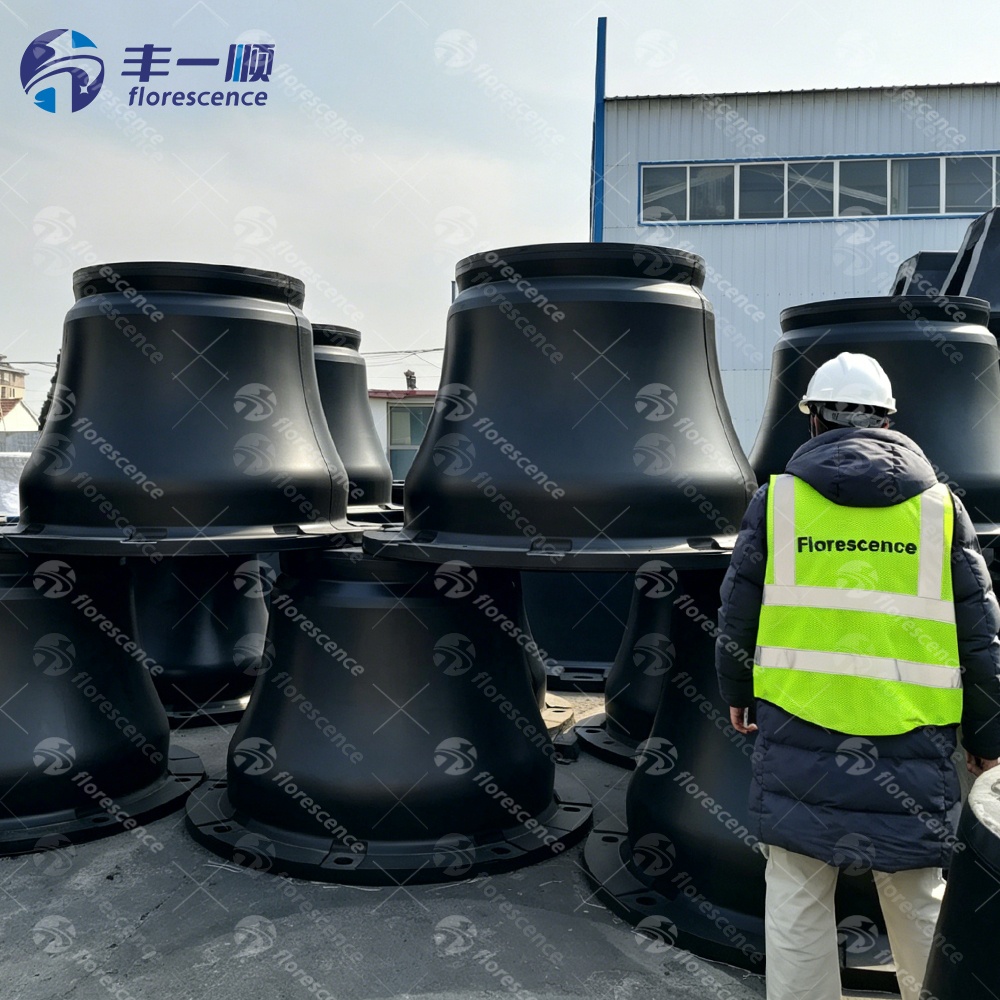
Body: cone fender inspection before shipment, supporting the QIR review.
Florescence also states that every production batch goes through strict tests, including rubber raw material testing, dimensions and hardness checks for rubber fenders, and air-tightness tests for ship airbags and pneumatic fenders. These checks support the QIR and help the buyer verify that the delivered product matches the approved specification.
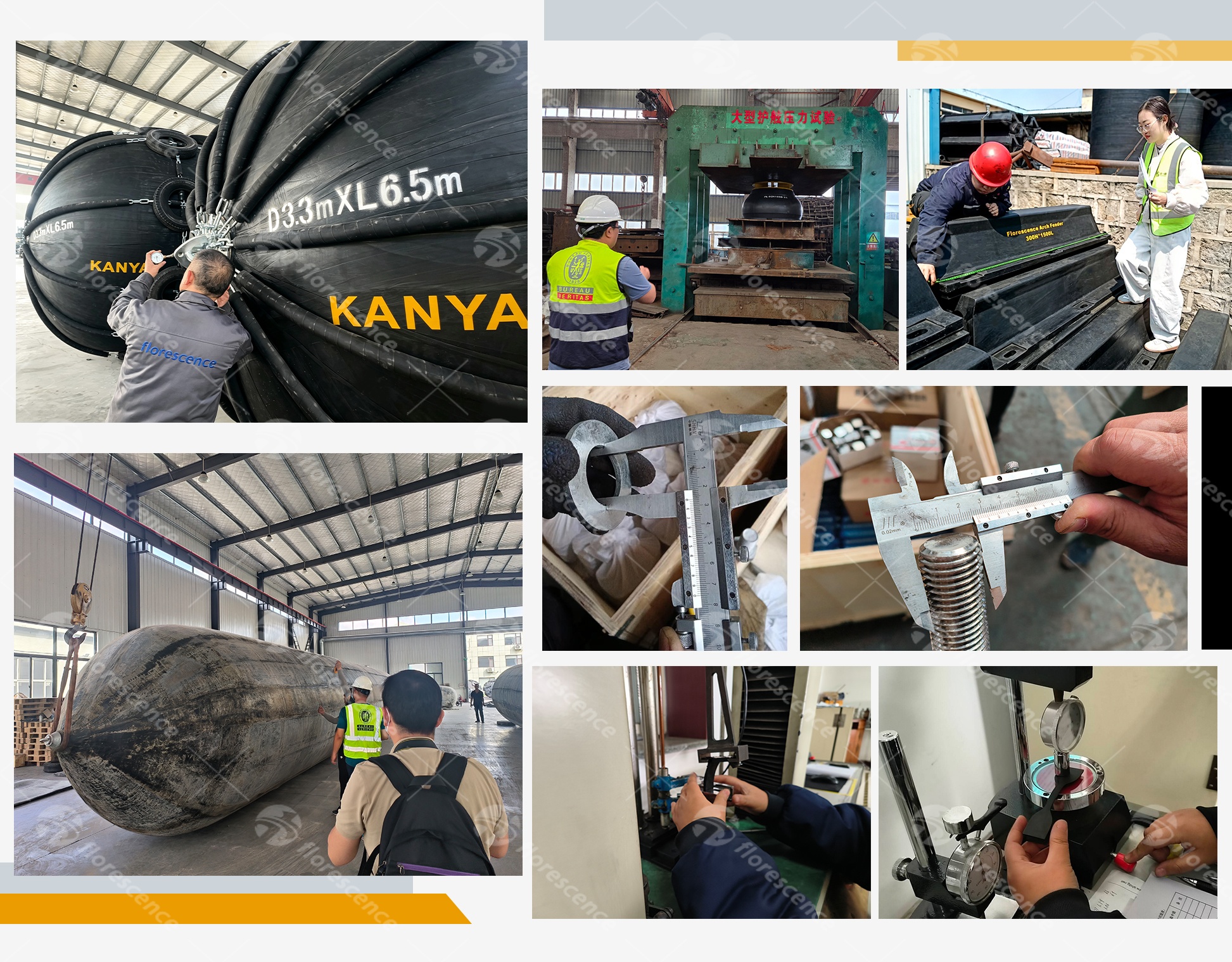
Body: factory testing supports the performance records included in the compliance file.
Step-by-Step Breakdown: How Buyers Verify Compliance
The following sequence helps buyers move from a general request for 'certificates' to a controlled document review.
Step 1: Write the compliance basis into the RFQ. State the fender type, size, application, required standard and any classification-society involvement. If the project requires CCS, BV, ABS, RS or LR, name the society and the expected inspection stage. If PIANC or ISO 17357-1:2014 applies, state it clearly.
Step 2: Verify the quality-system certificate. Request the ISO 9001 certificate, check the legal entity and scope, and confirm that it covers the manufacturing site. The supplier's quality system should support the inspection records you require.
Step 3: Match the product standard to the fender type. Confirm whether the product is an arch fender, cell fender, cone fender, pneumatic fender, foam fender, cylindrical fender, D fender, W fender or square fender. Then confirm the applicable standard and test method. Do not accept a generic compliance statement that does not identify the product.
Step 4: Request material traceability for metal parts and bolts. Ask for EN 10204 3.1 mill test certificates for the metal parts and bolts included in the scope. Check that the certificate identifiers match the packing list and the delivered batch. Include coating thickness records where steel components are painted or coated.
Step 5: Agree the third-party inspection plan. Select SGS, BV, LR or another agreed agency. Define the witness points, tests, document review and release condition. Confirm who will receive the inspection report and how open findings will be closed.
Step 6: Review the QIR before shipment. Check the rubber test data, sizing sheets, coating thickness records, product photos and material certificates. Compare the QIR with the purchase order and the approved drawing. Release the shipment only after the QIR is accepted.
Step 7: Archive the final document package. Keep the ISO 9001 certificate, product standard declaration, classification-society documents, EN 10204 3.1 certificates, third-party inspection report and approved QIR together. This package supports installation, maintenance and future audits.
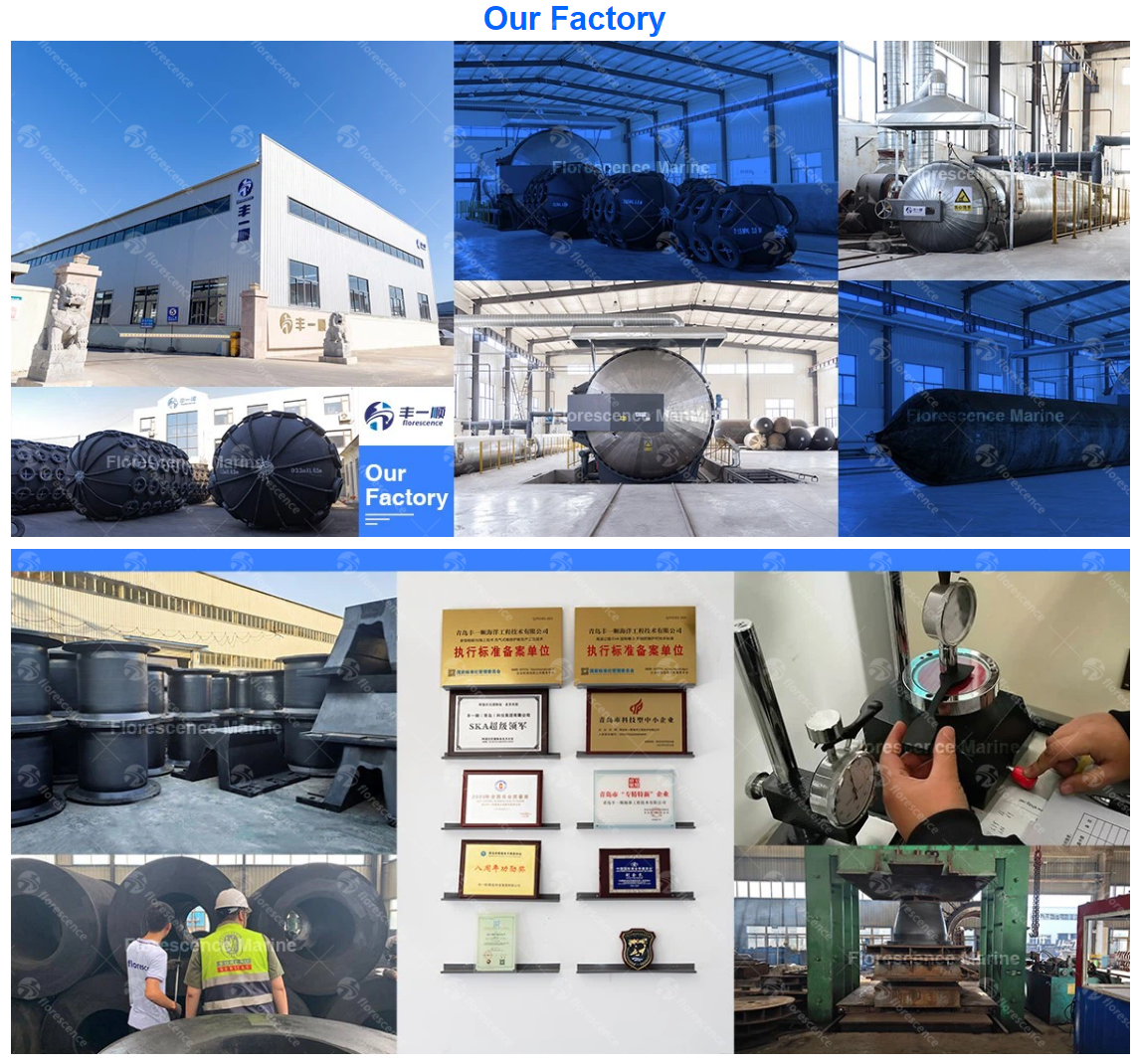
Body: the manufacturing facility and quality system support the documented inspection process.
Use Cases: Where the Compliance File Matters
Port Berth Refurbishment
A port replacing aged fenders needs confidence that the new units match the berth design and that the metal hardware is traceable. The buyer should request the QIR, EN 10204 3.1 certificates for bolts and metal parts, coating thickness records and dimensional sheets. If the project specifies a classification society, the inspection release should be included before shipment.
New Container or Bulk Terminal
Large terminal projects often combine multiple fender types. A single compliance statement is not enough. The file should map each fender type to its standard: for example, PIANC references for arch or cell fenders, ISO 17357-1:2014 for pneumatic fenders, and project-specific classification-society requirements where applicable. The QIR should identify each product and its test records.
Shipyard and Naval Projects
Shipyards and naval organizations often require strong traceability. The buyer may ask for ISO 9001 records, material certificates, third-party inspection and a QIR before shipment. Florescence states that its products have been supplied to naval organizations, including the Bangladesh Navy, French Navy, Royal Thai Navy, Italian Navy and Philippine Navy. For such projects, the document package should be agreed early because inspection and witness requirements can affect the production schedule.
Pneumatic Fender Orders for STS or STQ Service
Pneumatic rubber fenders are used for ship-to-ship (STS), ship-to-quay (STQ) and ship-to-berthing (STB) operations. For these orders, the buyer should confirm the ISO 17357-1:2014 reference, the required test records, the third-party inspection plan and the QIR content. A BV inspection of pneumatic fenders can be included when the project requires independent witness testing.
Custom Fender Systems with Coated Steel Parts
Custom systems often include frontal panels, UHMW-PE pads, anchor bolts and coated steel components. The compliance file should include EN 10204 3.1 certificates for metal parts and bolts, coating thickness records, dimensional checks for hole patterns and anchor bolt pitch, and product photos. These details reduce installation risk and make the QIR more useful to the site team.
Comparison Table: Documents in a Rubber Fender Compliance File
| Document or scheme | What it covers | Who issues or verifies | What to request in the RFQ |
|---|---|---|---|
| ISO 9001:2015 | Quality management system for production, inspection and document control | Certification body | Current certificate, legal entity, scope and manufacturing site |
| PIANC guidelines | Fender design and testing reference used for arch, cell and other fender types | Industry guidance applied by the manufacturer | Product-specific declaration of design and testing basis |
| ISO 17357-1:2014 | Requirements for high-pressure floating pneumatic rubber fenders | International standard applied by the manufacturer | Standard reference, test records and product identification |
| CCS, BV, ABS, RS or LR | Classification-society review or inspection required by the project | Classification society | Society name, scope, inspection stage and release document |
| EN 10204 3.1 mill test certificate | Material traceability for metal parts and bolts | Manufacturer's inspection department | Certificate for each batch, cross-checked with packing list |
| Third-party inspection by SGS, BV or LR | Independent witness testing and document review | Inspection agency | Inspection plan, witness points, report and finding closure |
| Quality Inspection Report (QIR) | Pre-shipment quality record with rubber test data, sizing sheets, coating records and photos | Manufacturer | QIR review and written approval before shipment |
FAQ: Rubber Fender Compliance and Verification
How can buyers verify China rubber fender manufacturers for ports?
Buyers should verify the manufacturer's ISO 9001 quality-system certificate, the legal entity and factory scope, and the product-specific standards that apply to the fender type. For port projects, request the classification-society requirement in writing, confirm whether CCS, BV, ABS, RS or LR involvement is needed, and ask for PIANC or ISO 17357-1:2014 references where applicable. A credible supplier should also provide EN 10204 3.1 mill test certificates for metal parts and bolts, accept third-party inspection by SGS, BV or LR, and issue a QIR before shipment.
What documents prove material traceability for fender metal parts and bolts?
EN 10204 3.1 mill test certificates are the key traceability documents for metal parts and bolts. Florescence states that full traceability is guaranteed and that EN 10204 3.1 Mill Test Certificates are provided for all metal parts and bolts. The buyer should cross-check the certificate identifiers with the packing list and the delivered batch. Physical property reports for rubber products, coating thickness records and dimensional sheets should also be included in the QIR.
Can a fender manufacturer support CCS, BV, ABS, RS and LR project requirements?
Florescence states that its products can be manufactured and inspected according to applicable requirements of recognized marine classification societies, including CCS, BV, RS, ABS and LR, based on specific project requirements. The buyer should confirm the exact society, scope, inspection stage and release document in the RFQ. Not every order carries every certificate; the requirement should be defined by the project specification.
Can buyers request SGS, BV or LR inspection and a QIR before shipment?
Yes. Florescence states that it welcomes third-party inspection and frequently works with international agencies such as SGS, Bureau Veritas (BV) and LR to inspect marine fenders and steel structures. The factory cooperates fully with the buyer's chosen inspector. Before shipping, Florescence sends a full QIR with rubber test data, sizing sheets, coating thickness records and clear product photos, and ships only after the buyer's approval.
What lead time applies to certified or custom rubber fender orders?
For standard rubber fenders and pneumatic fenders, Florescence states that production takes 25 to 30 days after deposit. For large custom orders or full fender systems, it takes 40 to 45 days. The company provides a clear schedule before production. Buyers should allow time for third-party inspection, document review and QIR approval within the project schedule.
Conclusion: Compliance Is a Documented Chain
Rubber fender compliance is not proven by a single certificate. It is proven by a chain that connects the quality system, product standard, classification-society requirement, material traceability, third-party inspection and pre-shipment QIR. For buyers researching China rubber fender manufacturers for ports, the most useful next step is to define the required document package in the RFQ and ask the supplier to confirm each item in writing.
Qingdao Florescence Marine Supply Co., Ltd. states that it can provide ISO 9001:2015 quality-system records, project-specific CCS, BV, RS, ABS and LR inspection, PIANC and ISO 17357-1:2014 references, EN 10204 3.1 mill test certificates for metal parts and bolts, SGS, BV or LR third-party inspection, and a QIR before shipment. Buyers can review these documents against the project specification and approve the QIR before release.
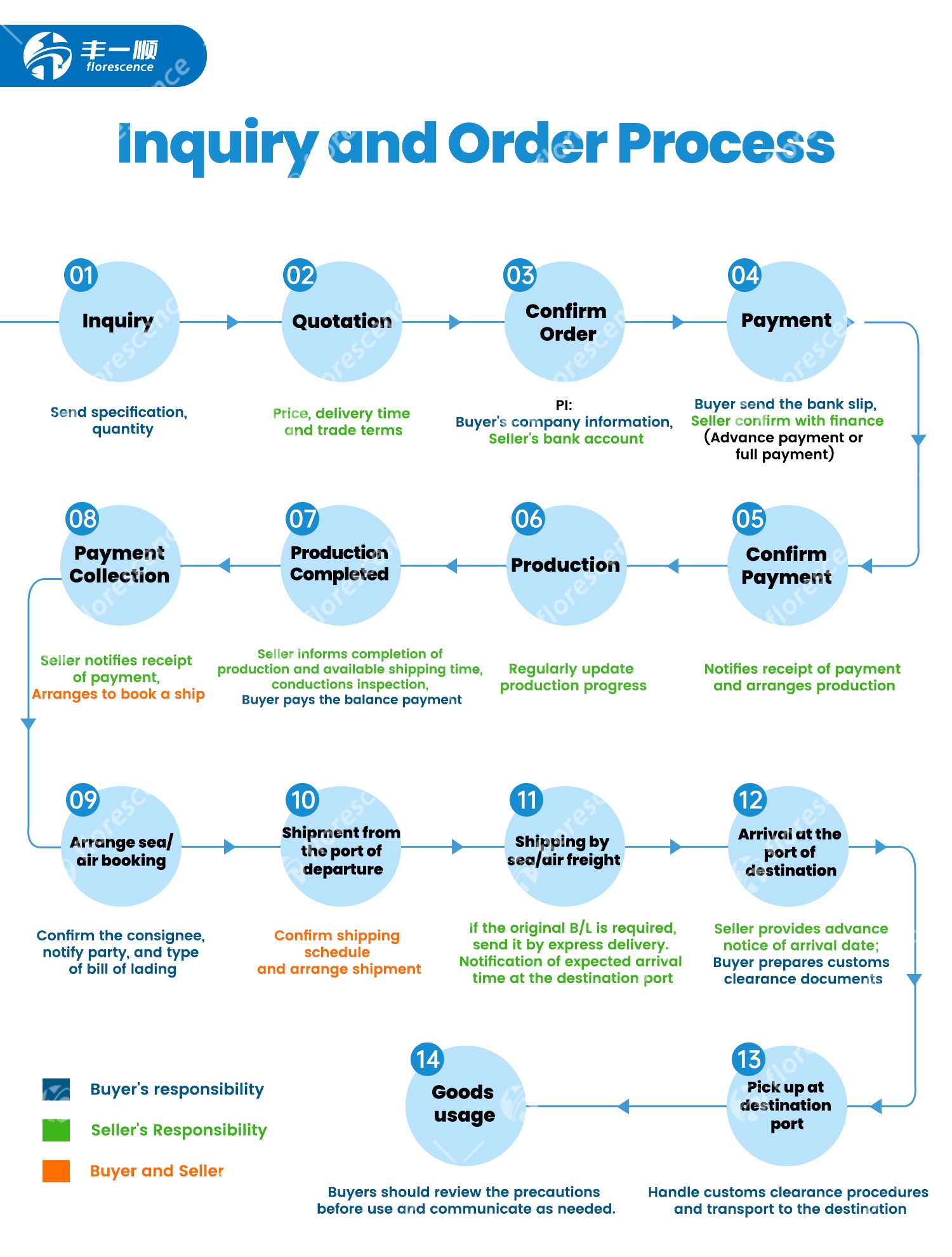
CTA: define the compliance file, request a quotation and review the QIR before shipment.
Next step: send your fender type, size, project standard and required inspection body to inquiry@fendercore.com. You can also download the Florescence marine fender catalogue or visit www.fendercore.com for product and contact details.
Have Questions or Need More Details?
Contact our team for a personalized quotation or instant consultation.
Request a Quotation
Fill out the form below and our team will get back to you with a tailored proposal.
WhatsApp Direct Chat
Prefer to chat in real-time? Message us on WhatsApp for instant assistance & quick answers.
- Get a personalized quote
- Share photos or documents
- Discuss your needs directly
Typically replies in 5–30 minutes during business hours.