
Ship Launching Airbag Compliance: ISO 14409, BV GTS 2025 154536 0003 and Regional Rules
Ship launching airbag compliance is decided by documents, not by the airbag alone. Three layers carry almost all the weight: ISO 14409:2011, the international product standard for ship launching air bags; a third-party attestation such as BV certificate GTS 2025 154536 0003, issued on 4 September 2025 for the global marine market; and the batch-level records that travel with the actual shipment. The most common compliance failure is not a defective airbag — it is a scope mismatch, where the buyer quotes a certificate number in a purchase order and nobody can show what that certificate actually covers.
Qingdao Florescence Marine Supply Co., Ltd — trading as Florescence Marine — is a marine rubber manufacturer established in 1992 in Qingdao, China, producing pneumatic rubber fenders, dock fenders, ship launching and salvage rubber airbags, with exports to Southeast Asia, South America, Europe, North America, the Middle East and Africa. This article sets out the compliance path a buyer should follow before ordering ship launching airbags, how to verify the scope behind a BV certificate number, and where regional documentation planning changes the sequence.
A deliberate limit applies throughout: this article does not restate the scope of BV certificate GTS 2025 154536 0003. The scope is defined by the certificate document itself. What follows is the method for reading it correctly and for matching it to an order.
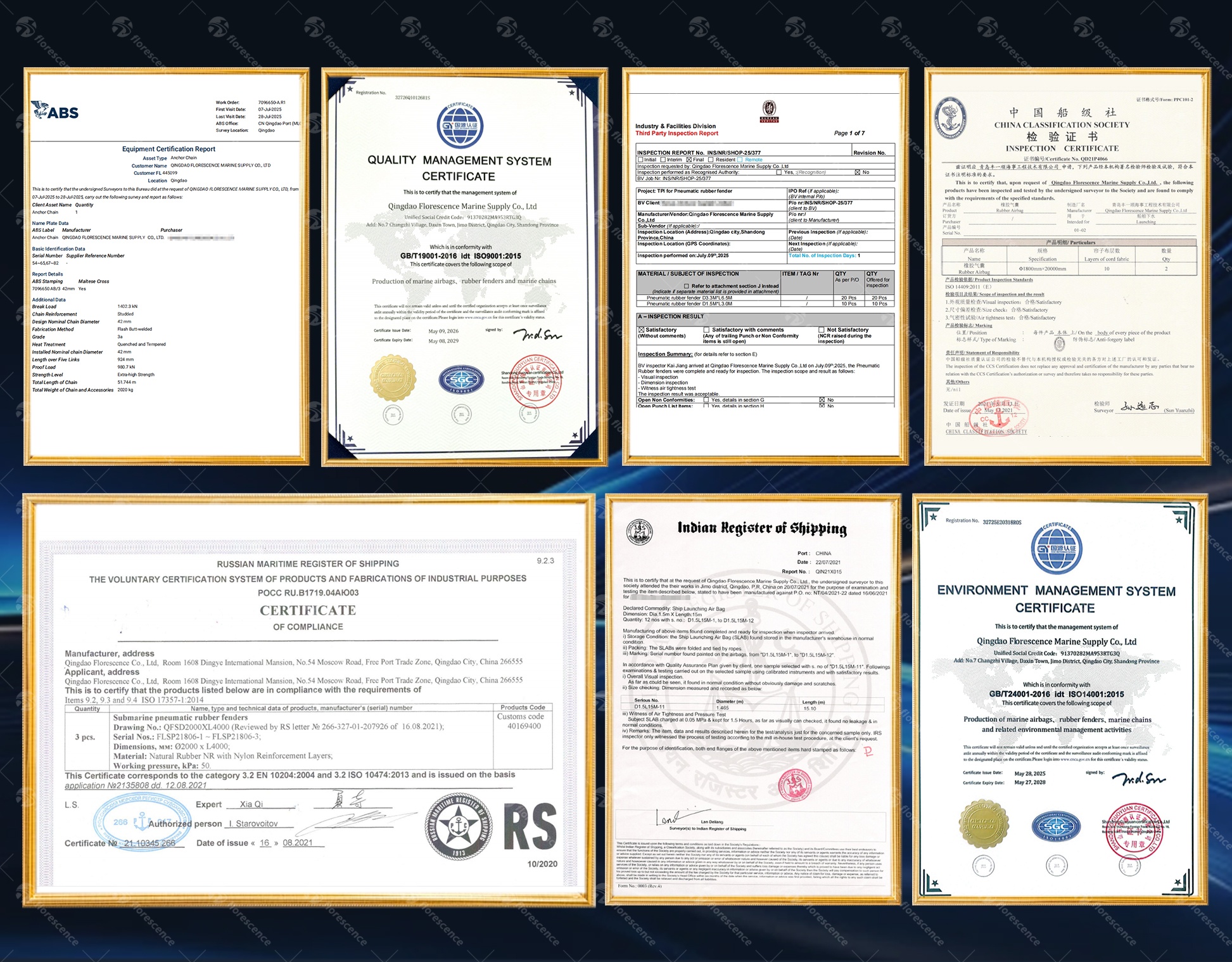
Certification and inspection records for marine rubber airbags — the document set a buyer should obtain before the purchase order, not after it.
Problem Definition: Why Airbag Compliance Usually Fails at the Document Level
Compliance problems in ship launching rarely originate in the rubber. They originate in four recurring gaps between what a buyer assumes and what a document states.
Gap 1 — Standard versus certificate. ISO 14409:2011 is a product standard. It defines the airbag as a product category, including its classification and testing basis. A certificate is a different instrument: it is a third-party attestation issued within a declared scope. Holding one does not automatically satisfy the other, and neither one approves a specific vessel launch.
Gap 2 — Certificate versus order line. A buyer orders diameter 2.0 m, length 12 m, a stated number of cord layers and a stated working pressure. The certificate may be issued against a product designation rather than against that exact combination. If nobody compares the two, a surveyor can reject the paperwork at the worst possible moment.
Gap 3 — Manufacturer document versus shipment record. A certificate describes the manufacturer's qualification. It says nothing about the batch on the water. The batch is evidenced by material test certificates, physical property reports and a quality inspection report.
Gap 4 — Global certificate versus regional rule. Depending on the project, the party asking for evidence may be a classification society surveyor, a port or harbour authority, an insurer, or a customs broker. Each asks a different question, and origin documents are not quality documents.
Industry Background: One Standard, Many Regional Expectations
ISO 14409:2011 — Ships and marine technology — Ship launching air bags — is the global foundational standard covering design, material and testing for this product category. Its most useful compliance feature for buyers is a classification split: ISO 14409:2011 classifies marine airbags into Ordinary (QP) and High-capacity (QG) categories. That two-letter designation is the single most portable piece of product language a buyer can put on a purchase order, because it is traceable to a published standard rather than to a supplier's brochure.
The same standard also sets safety-factor expectations for related duty. Marine salvage airbags, for example, require a minimum safety factor of 6:1 for buoyancy-related straps and lifting belts. Salvage and launching are frequently sold as one product family, but the safety logic is not interchangeable — a point worth confirming in writing when a single supplier is asked to cover both duties.
Why compliance documentation matters commercially right now: 360iResearch estimated the global marine airbags market at USD 328.82 million in 2025, rising to USD 346.59 million in 2026, and places Asia-Pacific at approximately 52% of global revenue with China acting as the primary manufacturing and export centre (source: 360iResearch, Marine Airbags Market Size & Share 2026–2032). In practice this means most marine airbag shipments cross a border before they reach a slipway. The certificate pack therefore has to survive not only a surveyor's review but an import file as well — two very different tests.
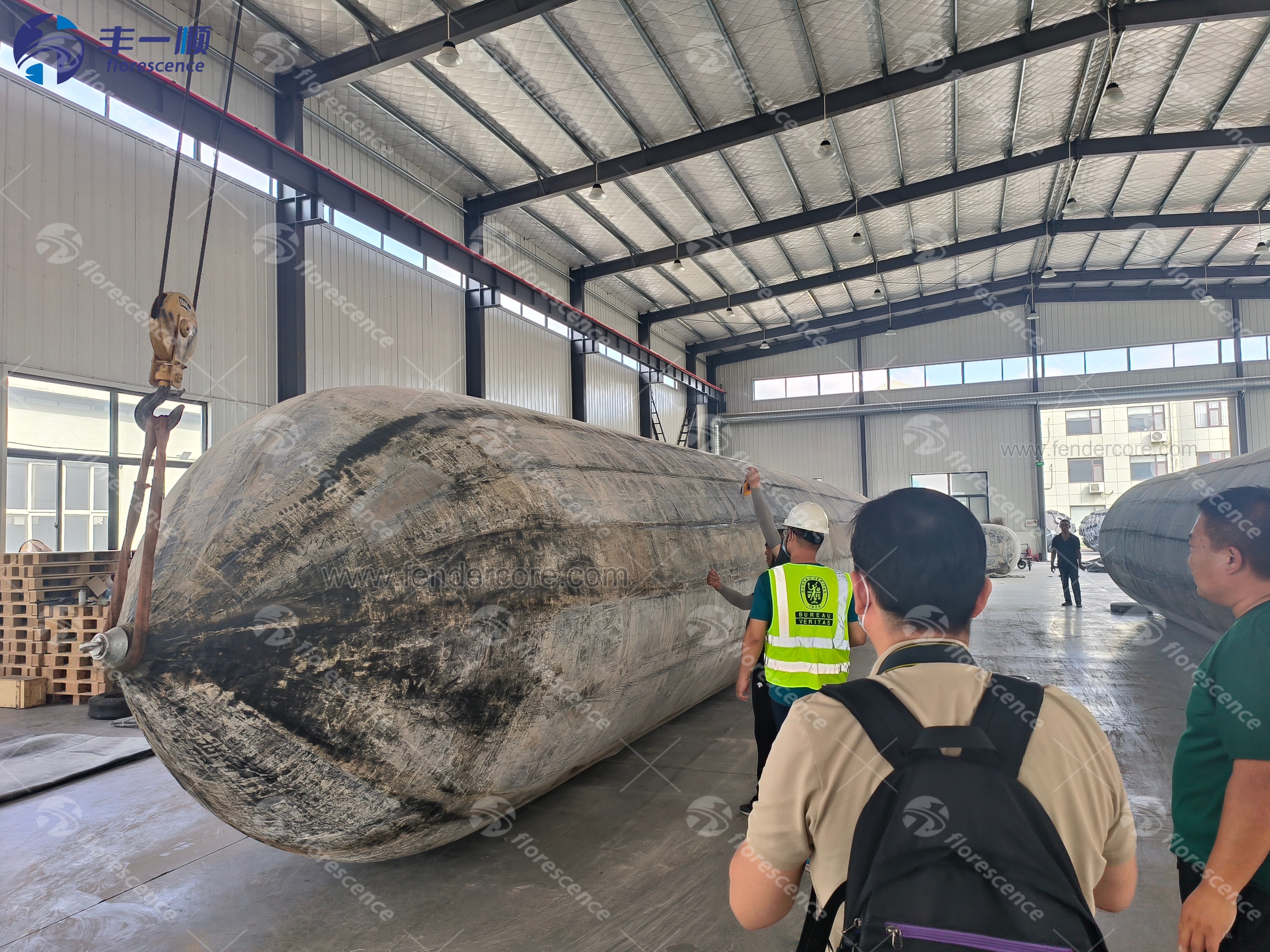
Batch-level inspection: raw material testing, dimensional checks and air-tightness testing are performed on every production batch.
The Three-Layer Compliance Path
A defensible compliance file for ship launching airbags is built in three layers, in this order. Each layer answers a different question, and no layer substitutes for another.
Layer 1 — ISO 14409:2011: the product and its class
The standard answers: what product category is this, and against what basis was it designed and tested? For a buyer, the deliverable from this layer is a written product declaration stating the ISO 14409 class (QP or QG), the diameter, the effective length and overall length, the number of reinforcement layers, and the working pressure. Airbag configurations commonly range from 3 to 12 layers depending on working pressure and project requirements, and diameter, length, pressure rating, reinforcement layers and end structure can all be customised. That flexibility is precisely why the declaration has to be itemised: a custom build moves away from a catalogue line, and the standard reference is what keeps the specification legible to a third party.
Layer 2 — BV certificate GTS 2025 154536 0003: the third-party attestation
The certificate answers a narrower question: has an independent body attested to this manufacturer's product within a defined scope? BV certificate GTS 2025 154536 0003 was issued on 4 September 2025 for the global marine market. Three things follow from that description, and all three matter to a procurement team.
- It is dated. An issue date creates a reference point for revision control. When a supplier's process, material or product range changes, the certificate pack should be re-checked rather than assumed current.
- It is scoped, not universal. A certificate of this type attests within its declared scope. It does not certify every size, every pressure class or every product the manufacturer sells, and it does not approve a specific vessel's launching calculation.
- It is global in market intent, not regional in legal effect. A certificate issued for the global marine market travels well, but local import, port and project requirements still apply on arrival.
Florescence states that its products can be manufactured and inspected according to the applicable requirements of leading marine classification societies, including CCS, BV, RS, ABS and LR, based on specific project requirements. That is a route to project-level conformity — it sits alongside the certificate, not inside it. Where a project names a society the certificate does not address, the correct action is a project-specific inspection arrangement, agreed before production.
Layer 3 — batch and shipment records: the evidence for this delivery
The third layer answers: what was actually made and tested for this order? Four record types do the work.
- Batch-level inspection records. Every production batch is inspected, covering rubber raw material testing, dimensional and hardness checks for rubber fenders, and air-tightness testing for ship airbags and pneumatic fenders.
- Material traceability. Full material traceability is provided through EN 10204 3.1 Mill Test Certificates for all metal parts and bolts, together with physical property reports for rubber components covering properties such as tensile strength, elongation and compression.
- Quality Inspection Report (QIR). A full QIR with rubber test data, sizing sheets, coating thickness records and product photos is available to the customer before final payment. This is the single most useful document for a buyer who will not visit the factory.
- Origin and customs documents. Commercial Invoice, Packing List, Bill of Lading and Certificate of Origin (such as Form E, Form F or CO). These support clearance and duty treatment; they are not quality evidence.
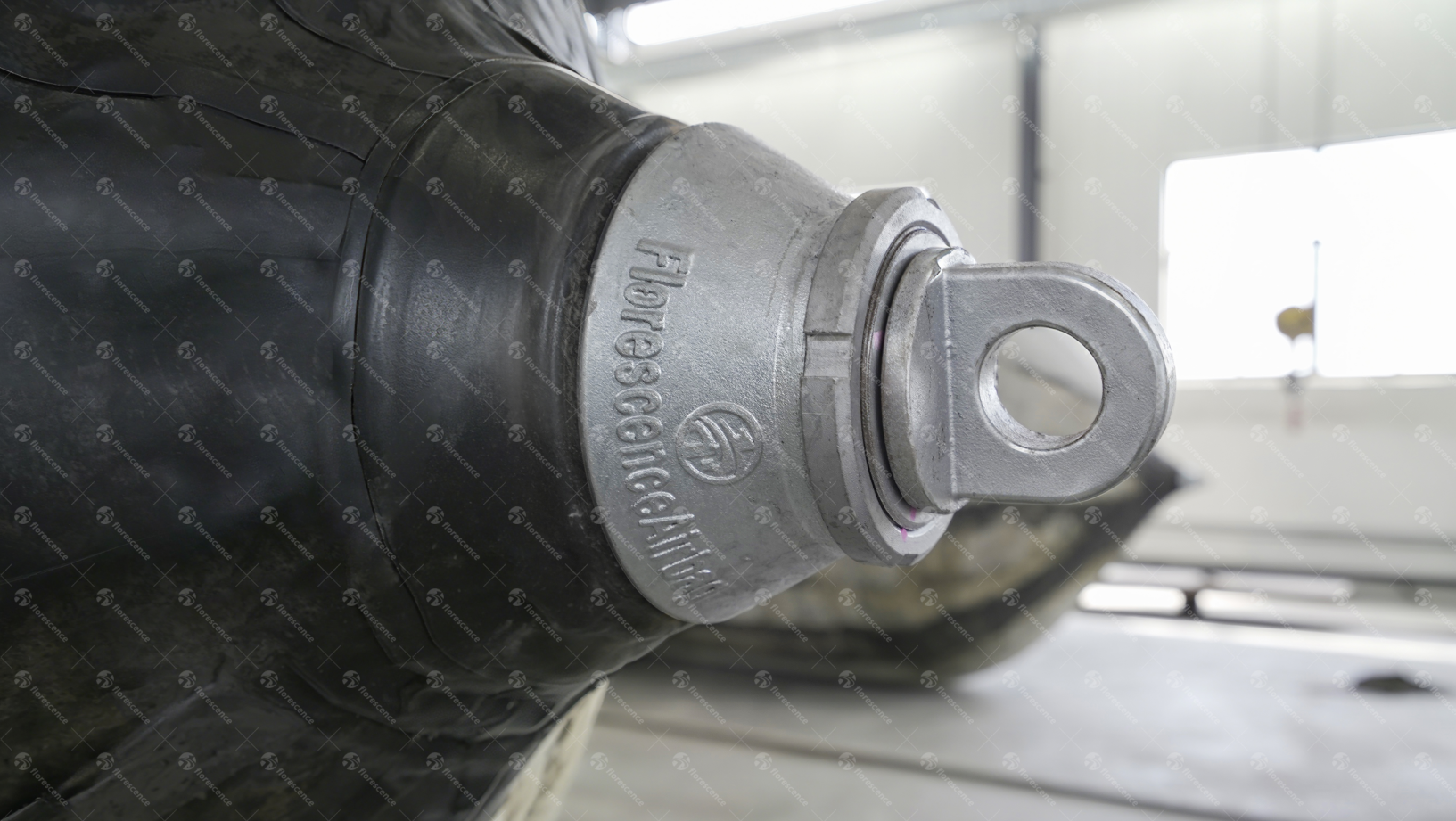
End fitting design and construction detail: the specification items a scope check should match line by line.
Step-by-Step: Verifying Scope Before You Order
The sequence below is written for a Decision-to-Execution buyer — someone who has already chosen a supplier and now has to make the paperwork survive review.
- Fix the product class in writing. State ISO 14409:2011 and the QP or QG designation on the enquiry and on the purchase order. Do not accept a generic 'ship launching airbag' description where the class could be either.
- Request the certificate as a document, not a number. Ask for the full certificate file for GTS 2025 154536 0003 and read the scope page: holder name, product designation, standard referenced, issue date (4 September 2025) and validity. A number in an email signature is not a scope.
- Match scope to order lines. Compare the declared product designation against the actual order: diameter, effective and overall length, layer count, working pressure and end fitting configuration. Any line outside the declared scope needs a written answer before the order is placed.
- Confirm the inspection route. Decide whether batch records alone are sufficient or whether a third-party witness is required. SGS, Bureau Veritas (BV) and LR inspections are accepted, and the factory cooperates with the buyer's chosen inspector.
- Build the regional document set. Confirm Incoterms and origin documentation for the destination. FOB is the usual quotation basis, and CIF, CFR, DDP or DDU terms can be arranged for sea or land transport. Sea freight, air freight, LCL and FCL shipment are all supported.
- File it for the service life, not the shipment. Ship Launching Airbags have a typical service life of 5 to 8 years, with reuse across multiple launching operations. A repeat order three years later will be reviewed against the certificate pack on file — so the pack has to stay current, not merely complete on day one.
Use Cases: How the Path Changes by Market
European and North American yards. Here the certificate layer usually comes first. A surveyor or client representative will ask what the attestation covers before discussing price, and a project-specific society requirement (ABS, LR, BV, CCS or RS) may sit on top of the general certificate. The practical move is to raise the project society requirement at enquiry stage, not at pre-shipment inspection.
Southeast Asian and Middle Eastern yards. Volume and schedule pressure dominate. Standard production lead time is approximately 25–30 days after deposit, while large custom orders or full fender systems run 40–45 days with a clear production schedule given before production starts. Because production and shipping status can be tracked in real time — weekly photos and videos of the vulcanisation process and final packaging, then container number and vessel tracking after shipping — documentation can be reviewed in parallel with production rather than after it.
South American importers, including first-time importers. Origin and clearance documents carry more weight here than in mature markets. Certificate of Origin (Form E, Form F or CO) alongside the Commercial Invoice, Packing List and Bill of Lading is the standard set. First-time importers are advised to engage a local import agent, and secure payment terms such as TT or L/C protect both sides.
Salvage and refloating contractors. The governing figure changes. Marine salvage airbags require a minimum safety factor of 6:1 for buoyancy-related straps and lifting belts, and salvage airbags carry a 5–8 year service life like their launching counterparts. A launching certificate quoted on a salvage tender does not answer the safety-factor question, and the two duties should be documented separately.
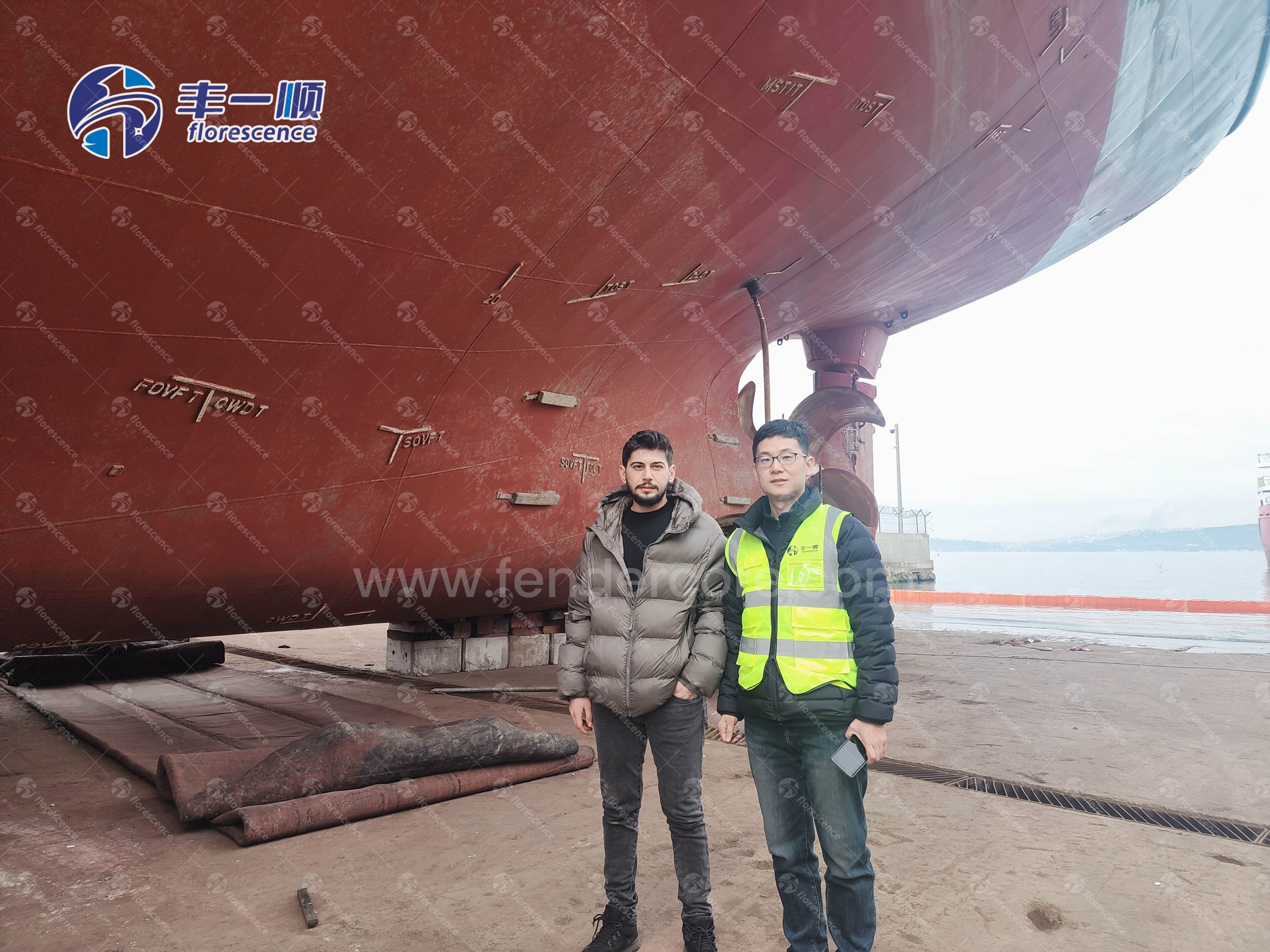
Marine launching airbags in operation. Regional documentation planning should start at enquiry stage, not at the loading port.
Comparison Table: What Each Document Proves
The table below separates the compliance layers by function. It is the fastest way to answer the question a surveyor or customs broker will actually ask.
| Document | What it evidences | What it does not evidence | Who issues it |
|---|---|---|---|
| ISO 14409:2011 standard reference (with QP or QG class declared) | The product category, design and testing basis, and the Ordinary (QP) or High-capacity (QG) classification | Does not certify a specific factory, batch or vessel launch | International Organization for Standardization (published standard) |
| BV certificate GTS 2025 154536 0003, issued 4 September 2025, global marine market | Third-party attestation of the manufacturer's product within the declared scope | Does not extend beyond the declared scope; does not approve a project-specific launching calculation | Bureau Veritas, obtained through the supplier |
| EN 10204 3.1 Mill Test Certificate | Material traceability for metal parts and bolts | Does not cover rubber compound performance | Supplier, on the basis of mill records |
| Physical property report for rubber components | Tensile strength, elongation and compression properties of the rubber | Is not a product-level certification | Supplier |
| Quality Inspection Report (QIR) | Batch conformance data, sizing sheets, coating thickness records and product photos, available before final payment | Is not a classification society approval | Supplier |
| Certificate of Origin (Form E, Form F or CO) | Origin of goods for customs and duty treatment | Is not a quality or compliance document | Issuing authority, arranged by the supplier |
FAQ
1. Does BV certificate GTS 2025 154536 0003 automatically cover every ship launching airbag size we order?
No. A certificate of this type attests within its declared scope, and the scope is defined by the certificate document itself — it is not implied by the certificate number. Before the purchase order, request the full certificate file for GTS 2025 154536 0003 (issued 4 September 2025 for the global marine market) and compare the declared product designation with your order lines: ISO 14409 class (QP or QG), diameter, effective and overall length, layer count, working pressure and end fitting configuration. If an order line falls outside the declared scope, ask for a written clarification or a project-specific inspection arrangement before production begins. Where a project names a society such as ABS, LR, CCS or RS, that requirement should also be raised at enquiry stage, because the manufacturer can manufacture and inspect to those applicable requirements based on specific project requirements.
2. Which documents should we plan for in each export region?
The shipment document set is the same in principle across destinations: Commercial Invoice, Packing List, Bill of Lading and Certificate of Origin (Form E, Form F or CO). What changes is the import requirement at the destination, which is why origin documentation should be confirmed at order stage rather than at the port. Florescence exports to Southeast Asia, South America, Europe, North America, the Middle East and Africa, and supports sea freight, air freight, LCL and FCL shipment, with packing methods optimised to reduce transportation costs and improve loading efficiency. FOB is the usual quotation basis, and CIF, CFR, DDP or DDU terms can be arranged for sea or land transport.
3. Can we inspect the batch before shipment, and when is the evidence released?
Yes. Every production batch goes through inspection covering rubber raw material testing, dimensional and hardness checks, and air-tightness testing for ship airbags and pneumatic fenders. Third-party inspection by agencies such as SGS, Bureau Veritas (BV) and LR is welcomed, and the factory cooperates fully with the buyer's chosen inspector. Full material traceability is provided through EN 10204 3.1 Mill Test Certificates for all metal parts and bolts, together with physical property reports for rubber components. A full Quality Inspection Report (QIR) with rubber test data, sizing sheets, coating thickness records and product photos is available before final payment, so approval happens before the balance is settled rather than after the container is sealed.
4. How long do production and documentation take?
For standard rubber fenders and pneumatic fenders, the standard delivery time for bulk orders is 25 to 30 days after deposit. For large custom orders or full fender systems, the delivery time is 40 to 45 days, and a clear production schedule is given before production starts. Documentation review can run in parallel: production and shipping status can be checked in real time through weekly photos and videos of the vulcanisation process and final packaging, and the container number and vessel tracking links are sent immediately after shipping. If a delay occurs due to weather or port problems, the customer is informed immediately and the logistics team works with the shipping line on the fastest alternative routing.
5. What should we look for in a long-term ship launching airbag supplier with spare-parts support?
Start with product life, because it determines the reorder cycle. Ship Launching Airbags and Marine Salvage Airbags have a typical service life of 5 to 8 years, and the airbags are reusable across multiple launching operations — so a supplier relationship is really a multi-year documentation relationship. Look for three support elements beyond the certificate: spare parts support and repair kits for inflatable marine products, repair materials and maintenance recommendations for damaged airbags, and engineering assistance covering product selection, technical calculations, layout recommendations and installation guidance. Florescence has supplied products to the Bangladesh Navy, French Navy, Royal Thai Navy, Italian Navy and Philippine Navy, and has built long-term relationships with customers in many countries — experience that shows up mainly in how inspection requirements and delivery schedules are coordinated. To start a scope review, the Florescence catalogue is available here: Florescence Catalogue – Brief (PDF).
Conclusion
Ship launching airbag compliance is a three-document discipline. ISO 14409:2011 fixes the product category and its QP or QG class. A third-party attestation such as BV certificate GTS 2025 154536 0003, issued on 4 September 2025 for the global marine market, provides independent confirmation within a defined scope. Batch records — inspection data, EN 10204 3.1 mill certificates, physical property reports and a QIR — prove what was actually built for this delivery. Confusing any one of these for another is the failure mode that surfaces at the slipway.
For buyers moving from decision to execution, the controlling rule is simple: read the scope before you write the purchase order, and match it line by line to the airbags you are buying. Regional rules then sit on top of that foundation rather than replacing it — the certificate pack travels to Southeast Asia, South America, Europe, North America, the Middle East and Africa unchanged, while origin and import documents are planned per destination.
Next step: verify the scope against your specification
Send the vessel type, length, beam, weight at launching or docking, and keel block height, together with your required ISO 14409 class and destination port. The engineering team can respond with a recommended airbag size and quantity, the applicable documentation set, and the inspection route for your project.
Qingdao Florescence Marine Supply Co., Ltd (Florescence Marine)
Website: www.fendercore.com
Email: inquiry@fendercore.com / info91@florescence.cc
Tel / WhatsApp: +86 182-0532-1693 (Michelle Zhang)
Address: 27th Floor, 10-2 Building, Optical Valley Software Park, Emeishan Road No. 396, Qingdao, China
Catalogue download: Florescence Catalogue – Brief (PDF)
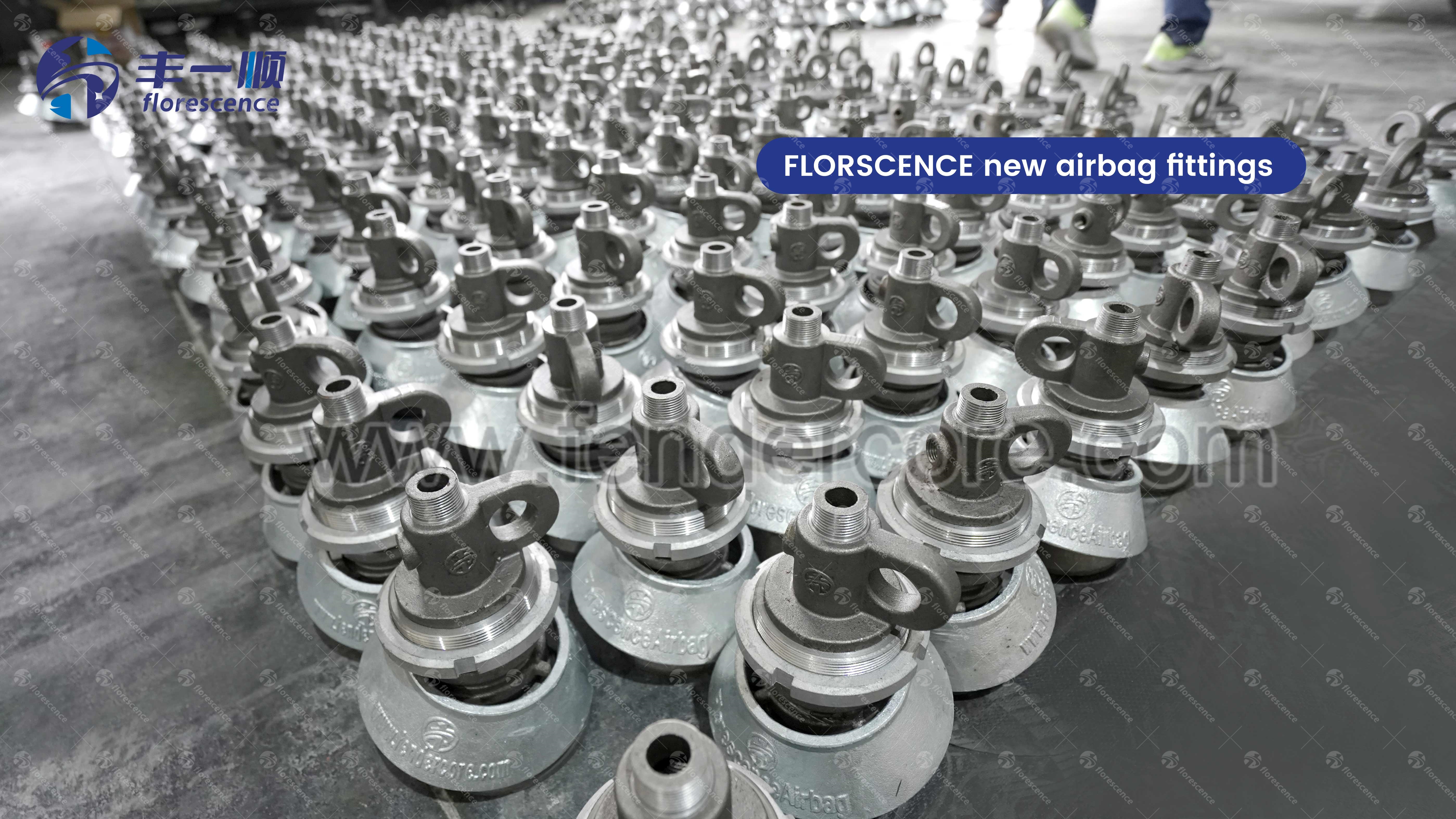
Supporting fittings and spare parts supplied with marine launching airbags — part of the long-term support package that follows the certificate.
Have Questions or Need More Details?
Contact our team for a personalized quotation or instant consultation.
Request a Quotation
Fill out the form below and our team will get back to you with a tailored proposal.
WhatsApp Direct Chat
Prefer to chat in real-time? Message us on WhatsApp for instant assistance & quick answers.
- Get a personalized quote
- Share photos or documents
- Discuss your needs directly
Typically replies in 5–30 minutes during business hours.