
Ship Launching Airbags: Five Buyer Profiles to Put on Your Shortlist
Short answer: the right supplier of Ship Launching Airbags is the one whose product class, certificate scope and documentation match your actual job — not the one quoting the lowest unit price. Five buyer profiles belong on most shortlists: the first-time importer, the shipyard launching a vessel in the 1,000-tonne class, the salvage and refloating contractor, the export-project buyer, and the buyer who needs custom or OEM airbags. Each profile points to a different product — standard Ship Launching Airbags, Marine Salvage Airbags, or custom marine airbags — and each should be scored against different evidence.
This guide is published on the Florescence Marine blog. Qingdao Florescence Marine Supply Co., Ltd. (Florescence Marine) is a Chinese marine rubber manufacturer established in 1992 that produces pneumatic rubber fenders, ship and dock rubber fenders, foam fenders, and ship launching and salvage rubber airbags at a 40,000 m² facility in Qingdao. The profiles below use Florescence's verified company, certificate and project facts as the reference point; the selection logic applies to any qualified manufacturer you decide to evaluate.
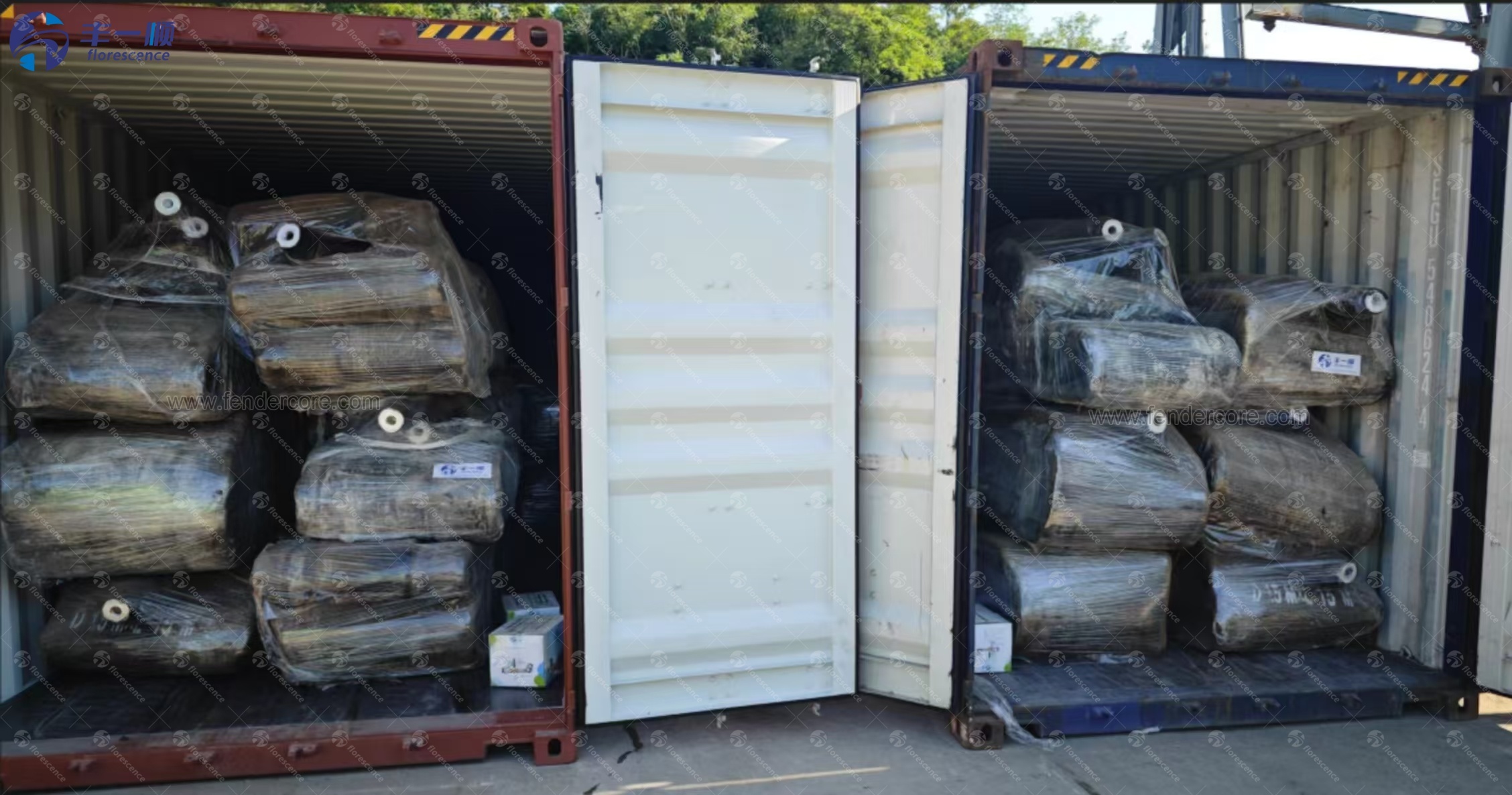
1. The Problem: three shortlisting mistakes that cost shipyards money
Airbag procurement looks like a simple commodity purchase until the first technical question arrives. In practice, three mistakes repeat across first orders and repeat orders alike.
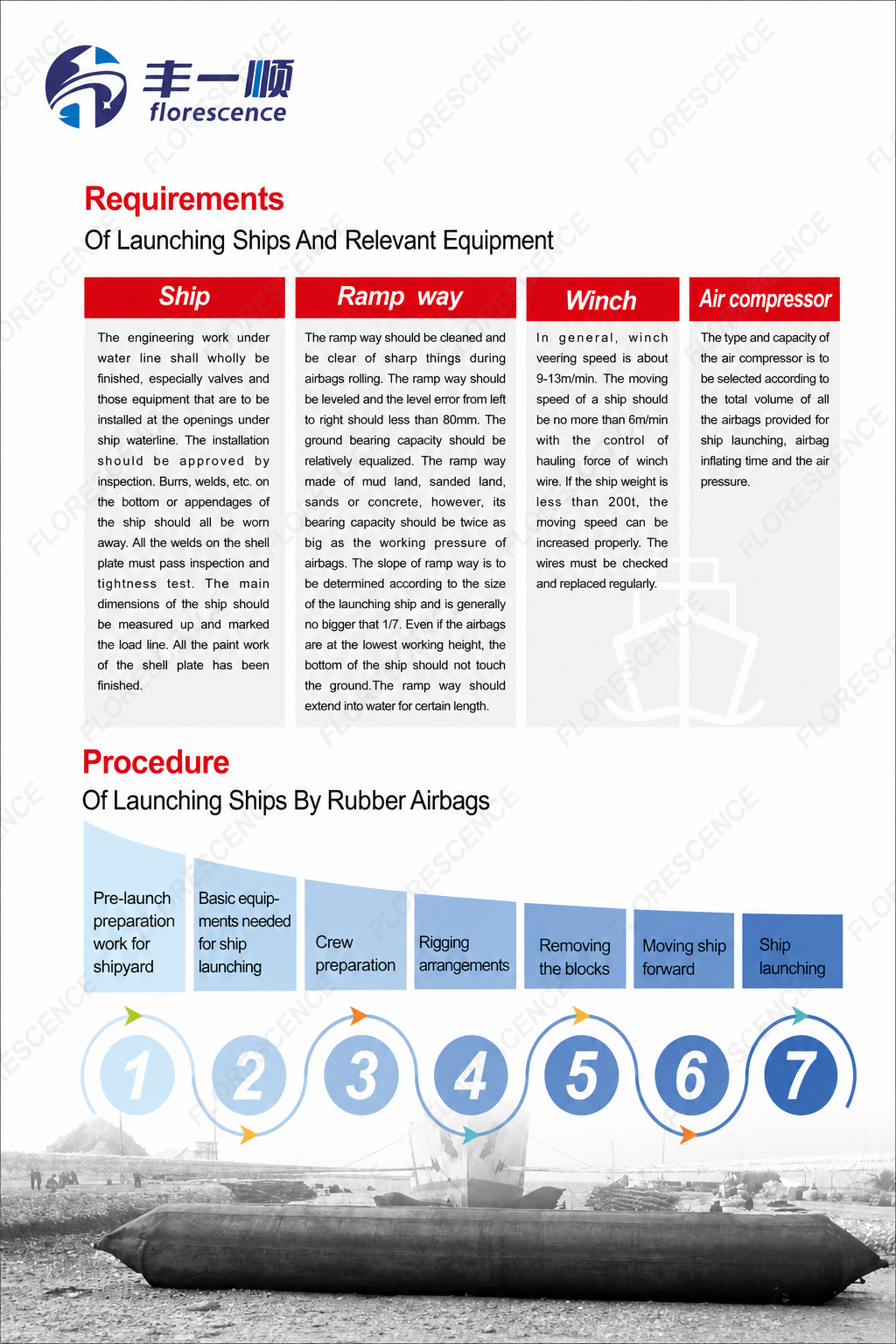
Mistake one: buying a launching airbag for a salvage job. Ship Launching Airbags and Marine Salvage Airbags share a material system, a size range and a layer count, so they are frequently quoted as if they were interchangeable. They are used differently: launching airbags are positioned, inflated, rolled and retrieved on a slipway, while salvage airbags work as buoyancy devices under or beside a submerged structure. The accessories differ as well — launching units are typically supplied with a valve, pressure gauge, pulling ring, three-way connecting tube and hose joint, while salvage units are supplied with an inflation valve, pressure gauge and pulling ring.
Mistake two: specifying layer count by habit. Airbag configurations range from 3 to 12 layers, with diameters from 0.6 m to 2.8 m and lengths from 5.0 m to 25 m. Choosing a familiar size instead of a calculated one changes ground clearance, rolling behaviour and the safety margin on a launch.
Mistake three: accepting a certificate that does not cover airbags. A classification society document is only as useful as its stated scope. A certificate issued for rubber fenders does not automatically cover marine airbags, and the scope line on the certificate — not the logo on the letterhead — is what procurement teams should read. For example, Florescence holds a BV certificate numbered GTS 2025 154536 0003, issued 4 September 2025, whose scope is marine rubber airbags, ship launching airbags and marine salvage airbags to ISO 14409; the company's separate BV certificates cover pneumatic fenders and cone fenders.
2. Industry Background: a concentrated market with a published standard
The global marine airbags market was estimated at USD 328.82 million in 2025 and is expected to reach USD 346.59 million in 2026, according to 360iResearch market estimates. The same source estimates that Asia-Pacific accounts for approximately 52% of global marine airbag revenue, with China acting as the primary manufacturing and export centre. For a buyer, that concentration has two consequences: most quotations will come from a small number of manufacturing regions, and the technical language used to compare them is therefore unusually standardized.
That standard is ISO 14409:2011 — Ships and marine technology — Ship launching air bags — which covers design, material and testing, and which classifies marine airbags into two categories: Ordinary (QP) and High-capacity (QG). A buyer who states the required category, rather than a generic “ship launching airbag”, removes most of the ambiguity from the comparison. In salvage work, the relevant safety expectation is a minimum safety factor of 6:1 for buoyancy-related straps and lifting belts on marine salvage airbags.
Because the standard defines testing as well as design, it also tells you what evidence to ask for: material and pressure test records, dimensional inspection, and where required a third-party witness by a classification society. Florescence, for instance, works to ISO 9001:2015 quality management requirements with certificate 32726Q10126RIS covering production of marine airbags, rubber fenders and docking fenders, and holds an IRS test report numbered QIN21X015 for ship launching air bags to ISO 14409.
3. The Five Buyer Profiles and What Each Should Shortlist
3.1 Profile one — the first-time importer
Who this is: a trading company, marine supply house or new shipyard buyer ordering airbags for the first time, usually as a trial quantity alongside fenders or other marine rubber products.
What to shortlist: standard Ship Launching Airbags from a manufacturer that can show a documented quality system and a product-level third-party certificate whose scope includes airbags.
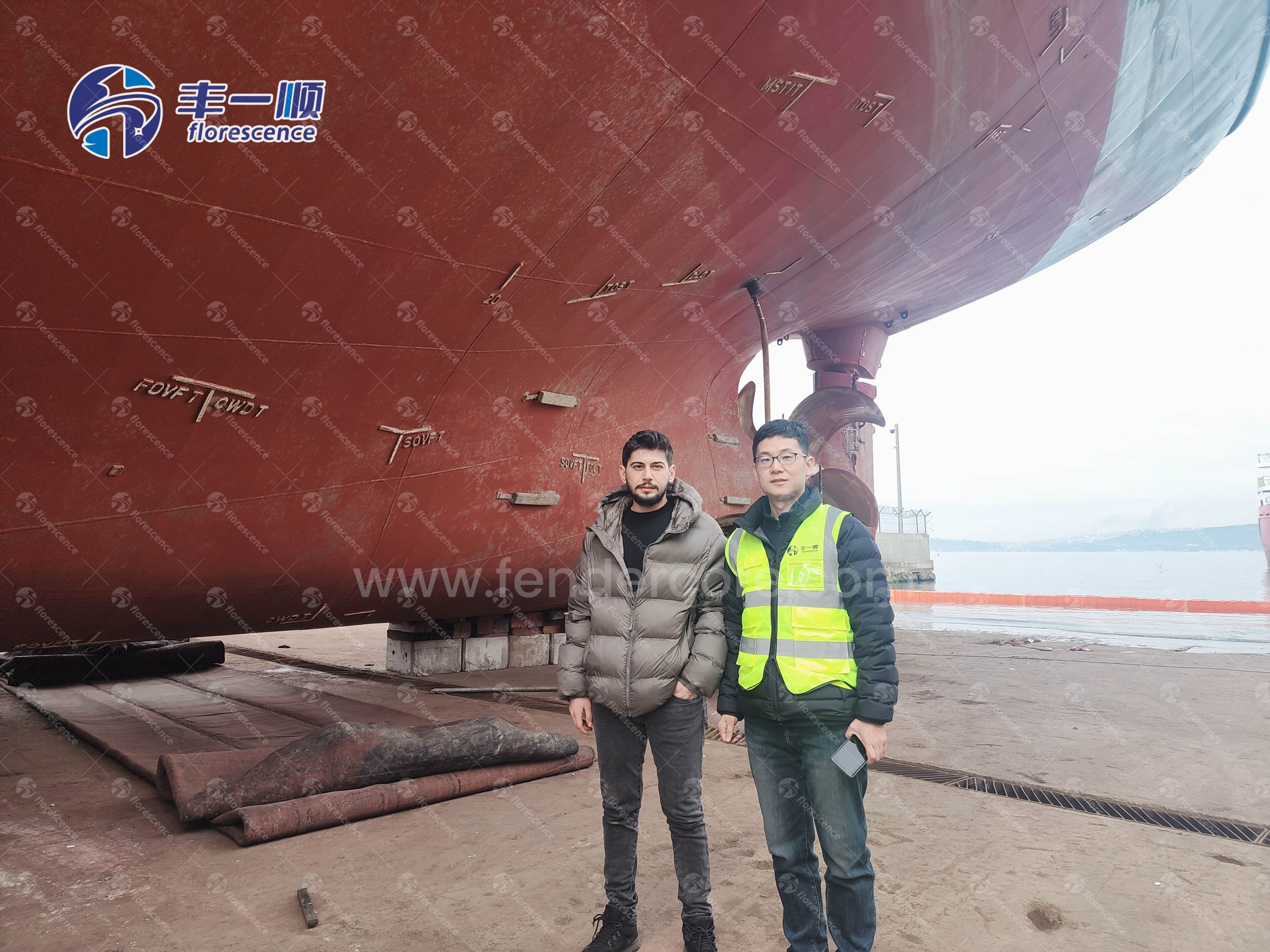
Why: on a first order, the dominant risk is not price — it is documentation, packing and specification mismatch. A manufacturer with a long production record reduces that risk because the paperwork already exists. Florescence has operated since 1992, runs a 40,000 m² facility with 120 staff and 25 R&D engineers, and produces around 2,000 pieces annually, with roughly 95% of output exported to Southeast Asia, South America, Europe, North America, the Middle East and Africa. A minimum order quantity of 1 unit and a lead time of 5–30 days make a single-unit trial commercially practical.
What to verify before you shortlist: the exact certificate scope line; whether the quoted pressure rating matches your vessel data; and how the supplier packs and documents a small shipment. First-time buyers should also ask for the operating procedure and safety notes in writing, because most launch failures attributed to “bad airbags” are actually procedural.
3.2 Profile two — the shipyard launching a vessel in the 1,000-tonne class
Who this is: a small-to-mid yard planning a slipway launch for a vessel of roughly 1,000 tonnes, where the launch package must be calculated rather than copied from a previous hull.
What to shortlist: large-diameter Ship Launching Airbags — a heavy-duty configuration in the 2.5 m diameter, 15 m length class, with the layer count confirmed by calculation.
Why: at this displacement, two things dominate: ground clearance under the keel and rolling efficiency on the slipway. A large-diameter airbag lifts the hull higher and rolls more smoothly than a small-diameter unit, which is exactly the design emphasis recorded in Florescence's Brazilian reference project: 13 units of 2.5 m diameter × 15 m length airbags, described as ISO 14409 compliant, multi-layer high strength, puncture and wear resistant, with an optimized large-diameter design for higher ground clearance and smoother rolling efficiency for large barges.
Size and quantity should not be selected from a catalogue table alone. The manufacturer should recommend airbag size and quantity from the vessel's length, width and weight. Florescence's stated service life for ship launching airbags is 5–8 years, and the Brazilian project records 8–10 years of durability under regular launching and slipway conditions.
What to verify before you shortlist: a written launch calculation covering diameter, length, layer count, working pressure and spacing; air-tightness test records for the batch; and a comparable reference in the same displacement range.
3.3 Profile three — the salvage and refloating contractor
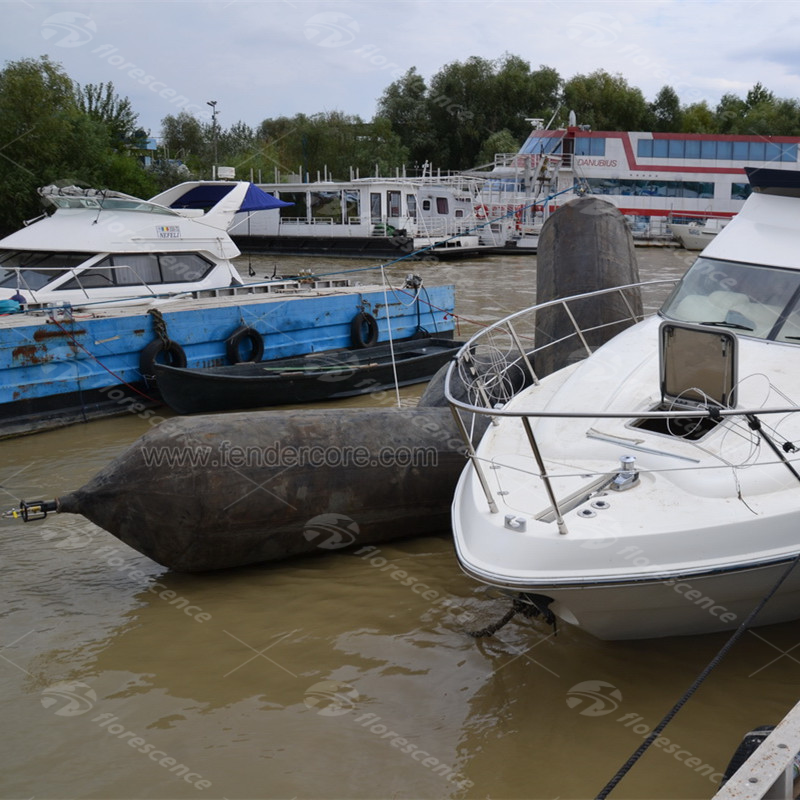
Who this is: a marine salvage company or diving contractor that needs buoyancy for sunken vessel refloating, shallow- and deep-water lifting, or emergency recovery.
What to shortlist: Marine Salvage Airbags — the same rubber-and-cord construction, but specified and supplied for buoyancy work rather than slipway rolling.
Why: salvage work has a different failure mode. The airbag is loaded underwater, often against an unknown or damaged hull surface, and the consequences of a puncture are immediate. That is why the safety expectation for buoyancy straps and lifting belts is a 6:1 minimum safety factor, and why puncture and wear resistance matter more than rolling efficiency.
Florescence's Romanian reference project covers 10 units of marine salvage airbags supplied to a marine salvage company, used for shallow- and deep-water boat salvage, sunken vessel refloating, heavy marine wreck lifting and emergency buoyancy support, with 6–8 years of service recorded under regular salvage and heavy-lifting conditions. The same size envelope applies: 0.6–2.8 m diameter, 5.0–25 m length, 3–12 layers.
What to verify before you shortlist: the stated safety factor on lift points and straps; pressure and material test records; whether the supplier can support an urgent schedule; and whether the quotation includes the fittings needed to manifold several airbags together.
3.4 Profile four — the export-project buyer
Who this is: a contractor, EPC buyer or project importer purchasing airbags against a fixed delivery window at a site outside the manufacturer's country — a newbuild yard, a dry dock upgrade or a salvage mobilisation.
What to shortlist: a supplier that can hold a project schedule, not just a product specification, across both Ship Launching Airbags and Marine Salvage Airbags.
Why: on project purchases, logistics and inspection documentation are as decisive as the airbag itself. Three checks shorten the list quickly. First, export experience: Florescence exports about 95% of output and ships to Southeast Asia, South America, Europe, North America, the Middle East and Africa. Second, freight flexibility: sea freight, air freight, LCL and FCL are all supported, with packing optimised to reduce transport cost and improve loading efficiency. Third, document set: commercial invoice, packing list, bill of lading and certificate of origin (Form E, Form F or CO) are provided for customs clearance.
Project buyers should also confirm how inspection will be handled. Third-party inspection by CCS, BV, ABS or DNV is performed on request, and a full quality inspection report — rubber test data, sizing sheets, test records and product photographs — should be released before the final payment. A BV certificate covering 13 units of D2.5 × EL15 airbags is an example of the product-level documentation a project file can carry.
What to verify before you shortlist: the written production schedule against your vessel date; the inspection body and witness arrangement; and whether the supplier will consolidate your airbags with other cargo at the loading port.
3.5 Profile five — the custom or OEM requirement
Who this is: a brand owner, distributor or specialist contractor that needs airbags built to a drawing — non-standard diameter or length, a specific pressure rating, branded marking, a particular end-fitting arrangement or project-specific packaging.
What to shortlist: custom marine airbags from a manufacturer with in-house engineering, not a trader who re-labels standard stock.
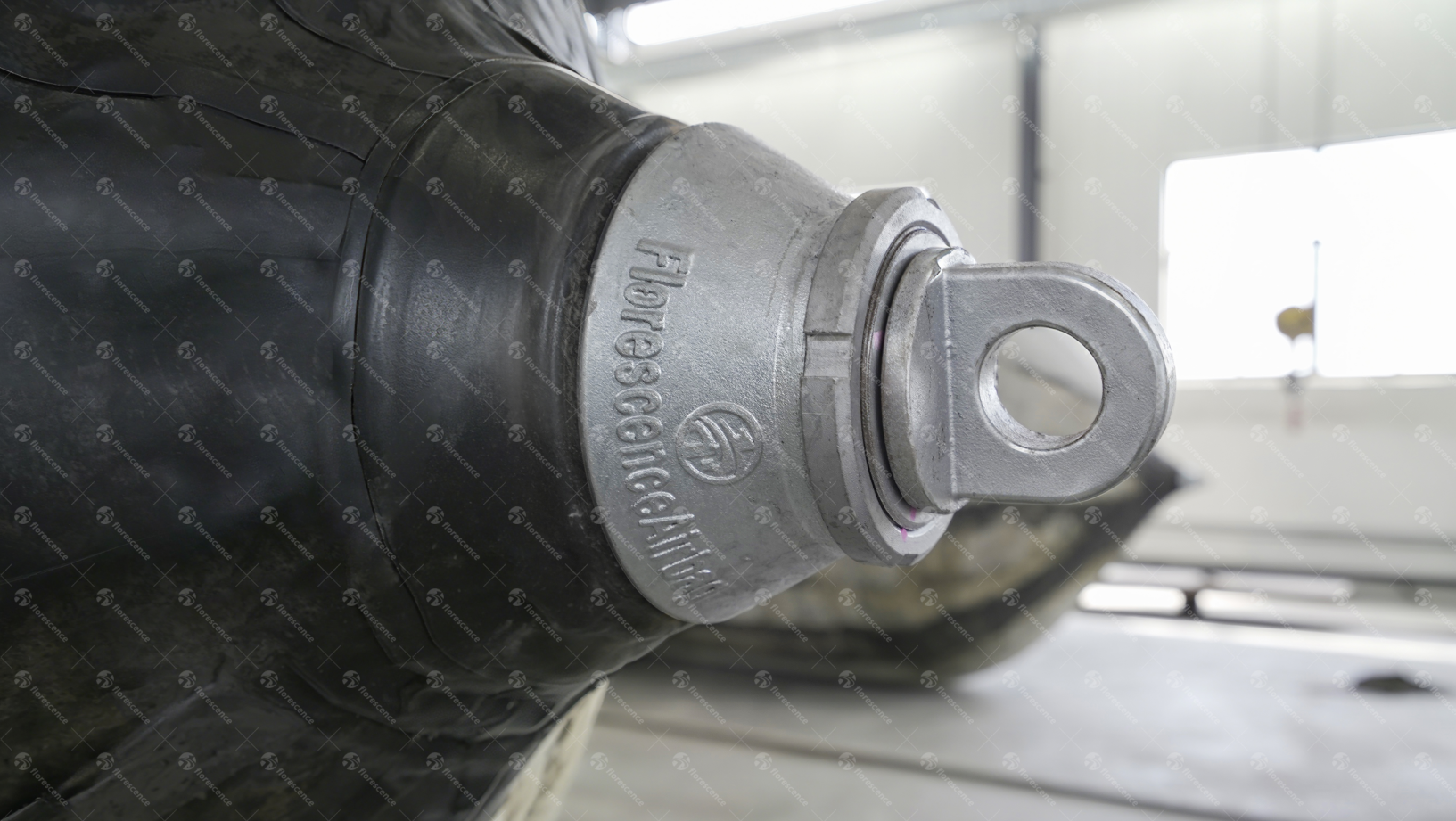
Why: customization is an engineering task before it is a commercial one. Florescence supports OEM/ODM production with customization of size, pressure, logo, fittings, package, solution and drawing, backed by 25 R&D engineers and a monthly capacity of 200 units. Standard airbag fittings include a valve, pressure gauge, pulling ring, three-way connecting tube and hose joint; custom end structures and fittings are produced to drawing.
A custom order should also be checked against the standard it must meet. If the airbag is destined for a classed vessel or a naval programme, the design must still satisfy ISO 14409 requirements for the QP or QG category you specify, and the inspection route must be agreed before production starts. Florescence's products have been supplied to naval organizations including the Bangladesh Navy, French Navy, Royal Thai Navy, Italian Navy and Philippine Navy — project experience that reflects familiarity with demanding specifications and inspection schedules.
What to verify before you shortlist: drawing approval before production; a written fittings and accessories list; confirmation of capacity against your delivery date; and whether repair kits and spare fittings are included in the package.
4. Step-by-Step: how to build and score the shortlist
Whichever profile you belong to, the shortlisting sequence is the same. Six steps are enough to separate a qualified supplier from a well-presented quotation.
- Classify the job, not the product. Write down whether the airbags will roll a hull down a slipway, lift a hull in a dry dock, move a heavy object overland, or provide buoyancy in a salvage operation. This single line determines whether you are buying Ship Launching Airbags, Marine Salvage Airbags or a mixed package.
- Fix the vessel and site data. Length, width, weight or displacement, slipway gradient and surface condition. Airbag size and quantity should be recommended from these inputs rather than selected from a stock table.
- State the standard and the category. Name ISO 14409 and specify QP (Ordinary) or QG (High-capacity). Add the third-party witness requirement — CCS, BV, ABS, DNV or another classification society — if the project needs it.
- Lock the configuration. Diameter between 0.6 m and 2.8 m, length between 5.0 m and 25 m, layer count between 3 and 12, working pressure, and the fittings list. For a 1,000-tonne launch, a 2.5 m × 15 m class unit is the reference point used in Florescence's Brazilian project; for salvage, the equivalent envelope applies but the fitting set differs.
- Verify the manufacturer's evidence. Quality system certificate and its scope, product-level third-party certificate covering airbags, test records for the batch, production capacity, and named project references. A manufacturer established in 1992 with a 40,000 m² facility, 120 staff, 25 R&D engineers and 2,000 pieces of annual output can be checked against exactly these points.
- Confirm the commercial and after-sales terms. Minimum order quantity, lead time, packing, documents, warranty period and spare-part support. Florescence quotes MOQ of 1 unit, lead time of 5–30 days, 24/7 online technical support, installation and repair guidance, 12–24 months warranty and free repair kits — terms worth comparing line by line across your candidates.
Score each candidate from 1 to 5 on those six steps and the shortlist usually resolves itself: the cheapest quotation rarely wins on steps four and five, and the most expensive rarely wins on step six.
5. Use Cases: matching the profile to the job
- Shipyard launching and landing: standard and heavy-duty Ship Launching Airbags on a ground or concrete slipway, with the launch package calculated from hull weight. Docking and undocking use the same product family.
- Heavy object land transport and vessel movement: marine airbags used to move or upgrade vessels and heavy structures where a crane or slipway is unavailable.
- Salvage and refloating: Marine Salvage Airbags for sunken vessel recovery, wreck lifting and emergency buoyancy, as in the Romanian salvage project.
- Multi-vessel programmes: yards launching several hulls from one slipway, where durability and reusability decide the total cost — the Brazilian project launched 13 barges with 13 units of 2.5 m × 15 m airbags.
- Branded and project-specific supply: distributors and contractors ordering custom marine airbags with defined markings, fittings and packaging.
6. Comparison Table: what each profile should shortlist
| Buyer profile | Product to shortlist | Decisive specification | Evidence to request |
|---|---|---|---|
| First-time importer | Standard Ship Launching Airbags, 3–12 layers | Layer count and pressure matched to vessel data | ISO 9001 certificate, third-party certificate with airbag scope, written size and quantity recommendation |
| 1,000-tonne vessel launch | Large-diameter heavy-duty Ship Launching Airbags, 2.5 m × 15 m class | Diameter and layer count for ground clearance and rolling efficiency | Launch calculation, air-tightness test record, comparable reference project |
| Salvage and refloating contractor | Marine Salvage Airbags, 3–12 layers | 6:1 minimum safety factor on buoyancy straps and lifting belts | Salvage case reference, pressure and material test report, fittings and manifold plan |
| Export-project buyer | Launching and salvage airbags under a project schedule | Lead time of 5–30 days against the vessel or site date | Commercial invoice, packing list, bill of lading, certificate of origin; CCS/BV/ABS/DNV inspection; weekly production photographs |
| Custom / OEM buyer | Custom marine airbags to drawing | Size, pressure, fittings, logo and packaging defined by drawing | Approved drawing, fittings list, capacity confirmation (200 units per month) |
Ship Launching Airbag vs Marine Salvage Airbag — the specification difference
| Attribute | Ship Launching Airbag | Marine Salvage Airbag |
|---|---|---|
| Material | Natural rubber with nylon cord | Natural rubber with nylon cord |
| Standard fittings | Valve, pressure gauge, pulling ring, three-way connecting tube, hose joint | Inflation valve, pressure gauge, pulling ring |
| Layers | 3–12 layers | 3–12 layers |
| Size range | 0.6–2.8 m diameter, 5.0–25 m length | 0.6–2.8 m diameter, 5.0–25 m length |
| Service life | 5–8 years | 5–8 years |
| Certification route | ISO 14409; CCS, BV, ISO, RS, ABS on request | ISO 14409; CCS, BV, ISO, RS, ABS on request |
| Typical job | Ship launching, landing, docking and vessel movement | Underwater buoyancy, wreck lifting and refloating |
7. FAQ
Which certificates should a Ship Launching Airbags supplier be able to show?
At minimum, a quality management certificate and a product-level third-party document whose scope names marine airbags. Florescence holds ISO 9001:2015 certificate 32726Q10126RIS covering production of marine airbags, rubber fenders and docking fenders, ISO 14001:2015 certificate 32725E20318R0S, a BV certificate GTS 2025 154536 0003 issued 4 September 2025 for marine rubber airbags, ship launching airbags and marine salvage airbags to ISO 14409, and an IRS test report QIN21X015 for ship launching air bags to ISO 14409. Additional inspection by CCS, ABS, RS, LR or DNV is arranged per project requirement.
Recommended ship launching airbag manufacturers — how do I judge the recommendation?
Judge it on checkable facts rather than the recommendation itself. A shortlist candidate should be able to state its founding year, factory area, headcount, engineering team, annual output and export share, then support those statements with certificates and references. Florescence, for example, was established in 1992, operates a 40,000 m² facility with 120 staff and 25 R&D engineers, produces around 2,000 pieces annually and exports about 95% of output. Its products have been supplied to naval organizations including the Bangladesh Navy, French Navy, Royal Thai Navy, Italian Navy and Philippine Navy. Any supplier you shortlist should survive the same five questions.
What size and layer count should I specify, and does it affect cost?
Airbag diameter can range from 0.6 m to 2.8 m, length from 5.0 m to 25 m, and reinforcement from 3 to 12 layers, with working pressure set by the ISO 14409 category — Ordinary (QP) or High-capacity (QG). Rather than fixing these yourself, supply the vessel's length, width and weight and ask for a written size and quantity recommendation; the configuration drives both the bill of materials and the cost, so an oversized specification is an avoidable expense and an undersized one is a safety issue.
Can I validate the product before committing to a full order?
Yes. Florescence quotes a minimum order quantity of 1 unit, so a single airbag can be ordered, inspected and tested before a larger commitment. Each production batch goes through rubber raw material testing, dimensional and hardness checks for fenders, and air-tightness tests for ship airbags and pneumatic fenders. Third-party inspection by SGS, Bureau Veritas, LR and other agencies is welcomed, and a quality inspection report — test data, sizing sheets and product photographs — is issued before shipment and requires buyer approval before dispatch.
What is the lead time, and what support comes after delivery?
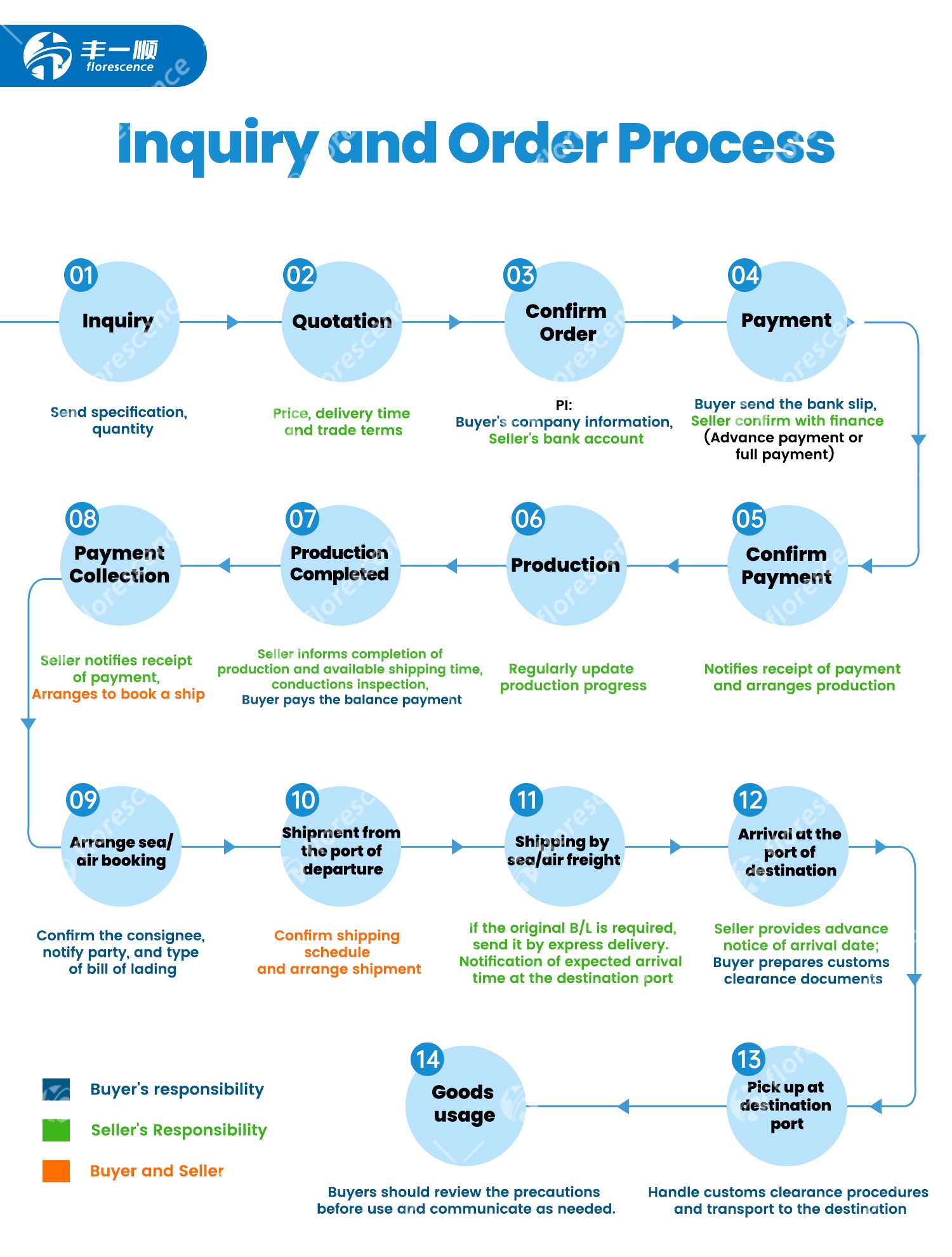
Quoted lead time is 5–30 days depending on airbag size, layer count and order volume, with project schedules confirmed in writing before production. After delivery, Florescence provides 24/7 online technical support, installation, use and repair guidance, global on-site service where required, a 12–24 month warranty and free repair kits and spare kits. For buyers who want to check specifications against a printed reference first, the Florescence catalogue (PDF) is available to download, and specific launch or salvage requirements can be sent to the technical team for a written recommendation.
8. Conclusion: shortlist by profile, then by evidence
The five profiles in this guide do not produce five different suppliers — they produce five different evidence checklists. A first-time importer needs certificate scope and a workable MOQ. A yard launching a 1,000-tonne vessel needs a calculated large-diameter configuration and a launch reference. A salvage contractor needs a 6:1 safety factor and a refloating case. A project buyer needs schedule, documents and third-party inspection. A custom buyer needs drawings, fittings and engineering capacity.
Once the profile is clear, the shortlist becomes a verification exercise: ISO 14409 category stated, configuration calculated, certificate scope read, capacity and references confirmed, and commercial terms compared line by line. Florescence Marine — established 1992, 40,000 m² facility, 120 staff, 25 R&D engineers, around 2,000 pieces of annual output and BV certification covering marine airbags to ISO 14409 — meets those checkpoints across all five profiles, and its Brazilian and Romanian projects show the two main applications in service.
Next step
Send your vessel length, width and weight, or the salvage lift requirement, and Florescence Marine will return a written airbag size and quantity recommendation with the matching layer count, fittings list and lead time. Single-unit orders are accepted for validation.
Email: inquiry@fendercore.com | WhatsApp: +86 182-0532-1693 | Website: www.fendercore.com
Have Questions or Need More Details?
Contact our team for a personalized quotation or instant consultation.
Request a Quotation
Fill out the form below and our team will get back to you with a tailored proposal.
WhatsApp Direct Chat
Prefer to chat in real-time? Message us on WhatsApp for instant assistance & quick answers.
- Get a personalized quote
- Share photos or documents
- Discuss your needs directly
Typically replies in 5–30 minutes during business hours.