
1,000-Ton Ship Launch with Airbags: Project Application Guide
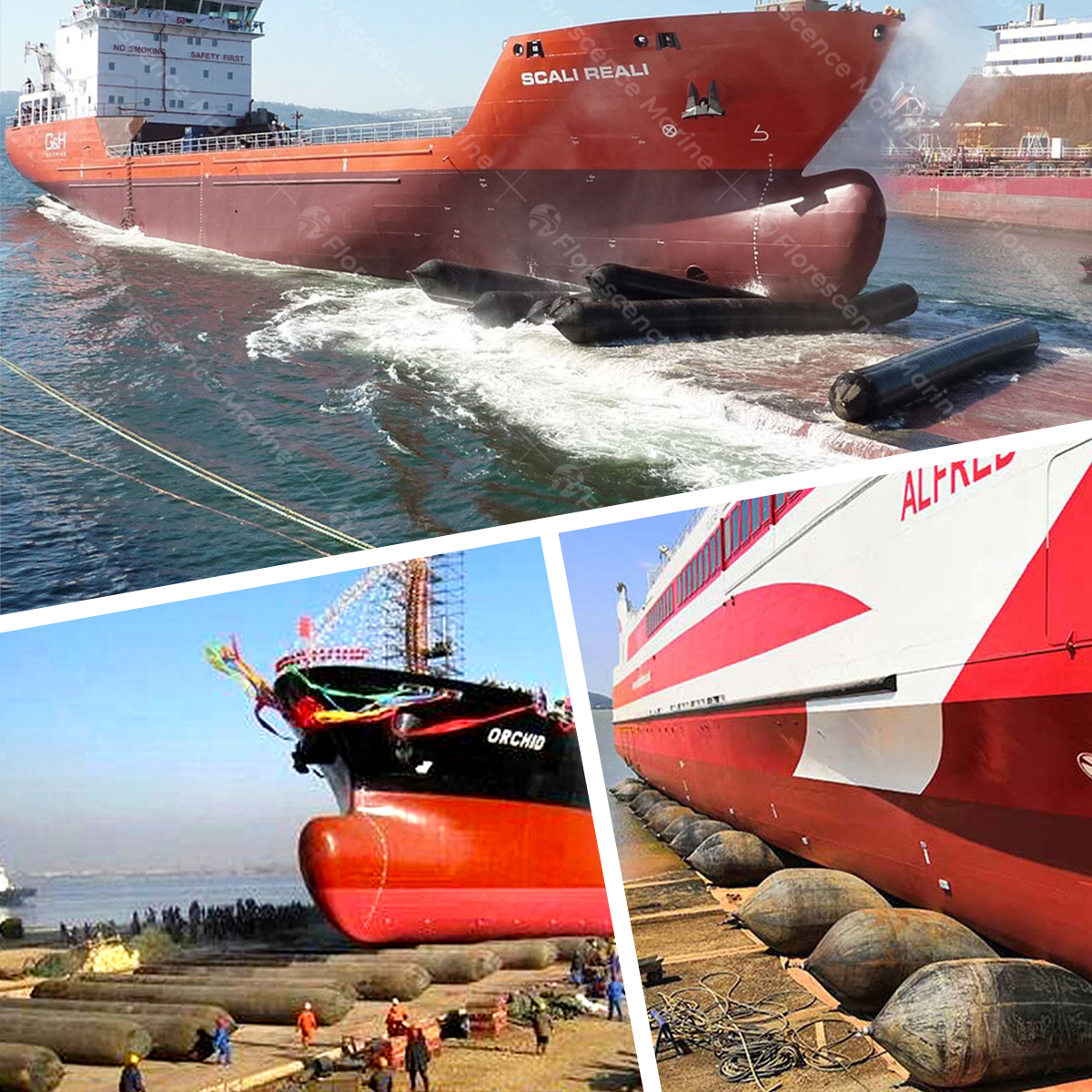
Launching a 1,000-ton vessel on ship launching airbags is a controlled rolling operation, not a single push. The hull is lifted off its keel blocks by a set of inflated rubber cylinders, held on a winch, and then allowed to roll down the slipway into the water. What decides whether the launch runs to plan is not one product choice but a sequence: airbag diameter, length and layer count, the spacing and quantity under the hull, the pressure verification before block removal, the condition of the slipway surface, and the retrieval plan after the vessel floats free.
This guide is written for shipyard engineers, project managers and buyers evaluating an airbag launch for a vessel in the 1,000-ton class. It follows the project from the sizing question through to retrieval, and it uses the published specification of the Ship Launching Airbag from Qingdao Florescence Marine Supply Co., Ltd, a Chinese marine rubber manufacturer established in 1992, together with ISO 14409 and third-party certification as the acceptance basis.
- Method: the vessel rolls on inflated rubber airbags restrained by a winch, then floats free.
- Core product: Ship Launching Airbag, natural rubber and nylon cord, 3 to 12 layers, diameter 0.6 to 2.8 m, length 5.0 to 25 m.
- Compliance anchor: ISO 14409, with CCS, BV, ISO, RS and ABS certificates available by project requirement.
- Typical sequence: positioning, inflation, block removal, rolling launch, retrieval.
The Real Project Problem: Load Transfer, Not Product Purchase
For a 1,000-ton vessel, the difficult moment is when the hull stops resting on keel blocks and starts resting on airbags. At that point the load path changes completely: the vessel weight is carried by the contact patch between the hull and each inflated bag, and that load is transferred into the slipway. If the bags are under-sized, under-inflated or unevenly spaced, the hull can distort, individual bags can be overloaded, or the vessel can start moving before the crew is ready.
Florescence states the relationship directly in its selection guidance: airbag bearing capacity depends on airbag diameter, working pressure, contact area, vessel weight and airbag quantity, and the manufacturer recommends size and quantity based on the vessel length, width and weight. That is the correct order of work for a 1,000-ton project. The vessel is defined first, the airbag set is calculated second, and the launch procedure is built around that set.
Three sub-problems sit inside that single load-transfer problem:
- Specification. Diameter, length, layer count and unit quantity must match the hull, not a catalogue page.
- Condition and documentation. The set must arrive with test evidence that the buyer can file, because a launch is not a repeatable trial.
- Site coordination. Slipway surface, winch arrangement, crew roles and pressure checks have to come together in one window.
Florescence lists four safety boundaries that the whole procedure is designed to protect: strict control of operating pressure with over-pressure forbidden, a slipway of ground or cement concrete sized to the vessel tonnage, no sharp objects on the slipway or the hull, and no distortion in the length direction during rolling and no overweight load after air charging. A 1,000-ton launch plan is essentially a plan for staying inside those four lines.
Industry Background: Why Airbags Are Used in This Range
Ship launching airbags developed as an alternative to greased slipways and fixed launching facilities. Florescence summarises the practical case: an airbag launch can take place at any seaside location, so there is no need to construct launching facilities; the bags need little maintenance and can be used repeatedly; and the operation requires no more than air compressors, winches and ropes. The same source describes airbags as cheaper and more portable than other methods.
The method now has a published standard behind it. ISO 14409:2011, Ships and marine technology, Ship launching air bags, defines the design, material and testing basis for the product and classifies marine airbags into two categories: Ordinary (QP) and High-capacity (QG). For a buyer, the practical meaning is that an airbag launch can be specified and inspected against a standard rather than against a supplier datasheet alone.
Market data points to a concentrated supply base. 360iResearch estimates the global marine airbags market at USD 328.82 million in 2025, rising to USD 346.59 million in 2026, with Asia-Pacific accounting for approximately 52% of global revenue and China acting as the primary manufacturing and export centre. Most 1,000-ton launches will therefore be sourced from Chinese manufacturers, which makes documentation and third-party inspection the deciding factors rather than product availability.
The Airbag Set for a 1,000-Ton Launch
Ship Launching Airbag: published specification
The Ship Launching Airbag is a natural rubber and nylon cord cylinder that lifts a vessel off its blocks, carries it while the blocks are removed, and rolls it into the water. Florescence publishes a launch and upgrade capability of up to 100,000 DWT for this product line, so a 1,000-ton vessel sits well inside the stated working envelope. The engineering effort goes into selecting the right combination from the available range rather than into extending the limits of the product.
- Material: natural rubber and nylon cord
- Reinforcement: 3 to 12 layers, depending on working pressure and project requirement
- Size range: diameter 0.6 to 2.8 m, length 5.0 to 25 m
- Service life: 5 to 8 years
- Compliance: manufactured to ISO 14409
- Certificates: CCS, BV, ISO, RS, ABS
- Fittings: valve, pressure gauge, pulling ring, three-way connecting tube, hose joint
- Working environment: high pressure rating, anti-ageing compound, seawater corrosion resistance, service range of −20 °C to 50 °C
Supporting equipment: the launch is a system
An airbag launch is never a single line item. The equipment list published for this application covers the pulling ring, terminal iron, protective cover, three-way connecting tube, pressure gauge, inflation valve, hose joint, high-capacity winch, wire rope, pulley system, shackle, air compressor and inflation hose.
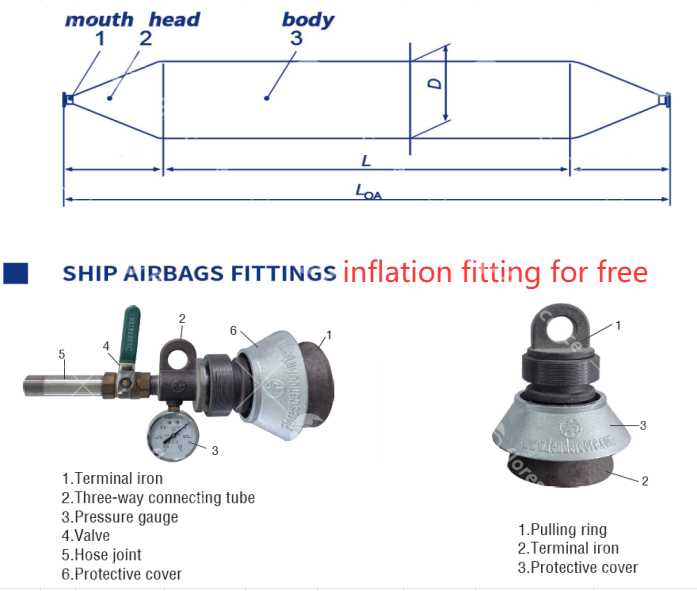
Two items on that list matter more than their unit cost suggests. The pressure gauge is what turns inflation from an estimate into a verified step, and the winch and wire rope are what hold the vessel on the slope before release. Florescence supplies fittings with airbag orders and includes repair kits and on-site instruction with the product.
Recovery and refloating support: Marine Salvage Airbag
Marine Salvage Airbags are the same airbag family applied to buoyancy work, and they are worth including in a launch plan as a contingency. Florescence builds them with a maximum working pressure of 0.25 MPa, usable to 25 m water depth, and a buoyancy of 10 to 50 tons per piece. The body is a fully enclosed tube with cone ends made by holistic screw technology, so there are no welded seams, which the manufacturer states makes them stronger than radio-frequency welded alternatives. They are supplied with rubber handles, nylon rope net and pulling rings.
ISO 14409 sets a minimum safety factor of 6:1 for buoyancy-related straps and lifting belts on salvage airbags, which is the figure to verify when a launch project also needs a recovery contingency. In low water season the same airbags can support a vessel launch up to 5,000 tons or a caisson launch up to 8,000 tons, and they can jack stranded vessels above 200 tons back into the water without dredging the channel or bringing in a crane.
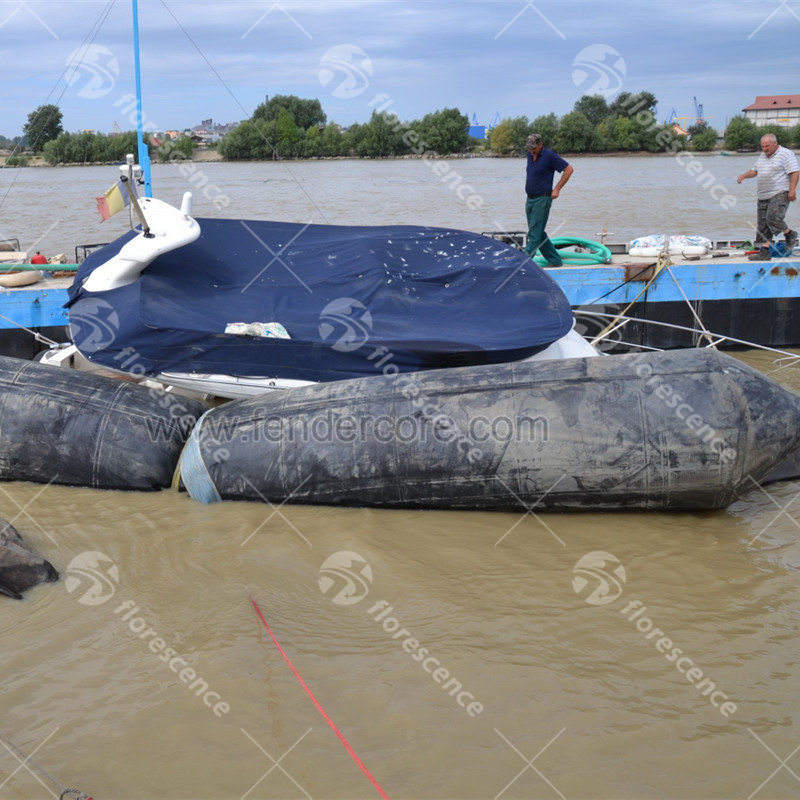
For a 1,000-ton project the salvage unit plays three possible roles: a contingency asset if the hull stops short of the water, a buoyancy aid if the launch window falls in low water season, and a support pontoon for docks or floating structures where rigid pontoons do not apply.
Acceptance basis: what the buyer should receive
Acceptance for a launch project should be documented rather than visual. The Florescence factory operates to ISO 9001, and every production batch goes through rubber raw material testing, dimensional and hardness checks, and air-tightness testing for ship airbags. Third-party inspection by SGS, Bureau Veritas or LR is accepted and routinely arranged. EN 10204 3.1 mill certificates are issued for metal parts, together with physical property reports covering tensile strength, elongation and compression for the rubber. A full Quality Inspection Report with test data, sizing sheets and product photographs is issued before shipment, so the buyer approves the actual set before it leaves the factory.
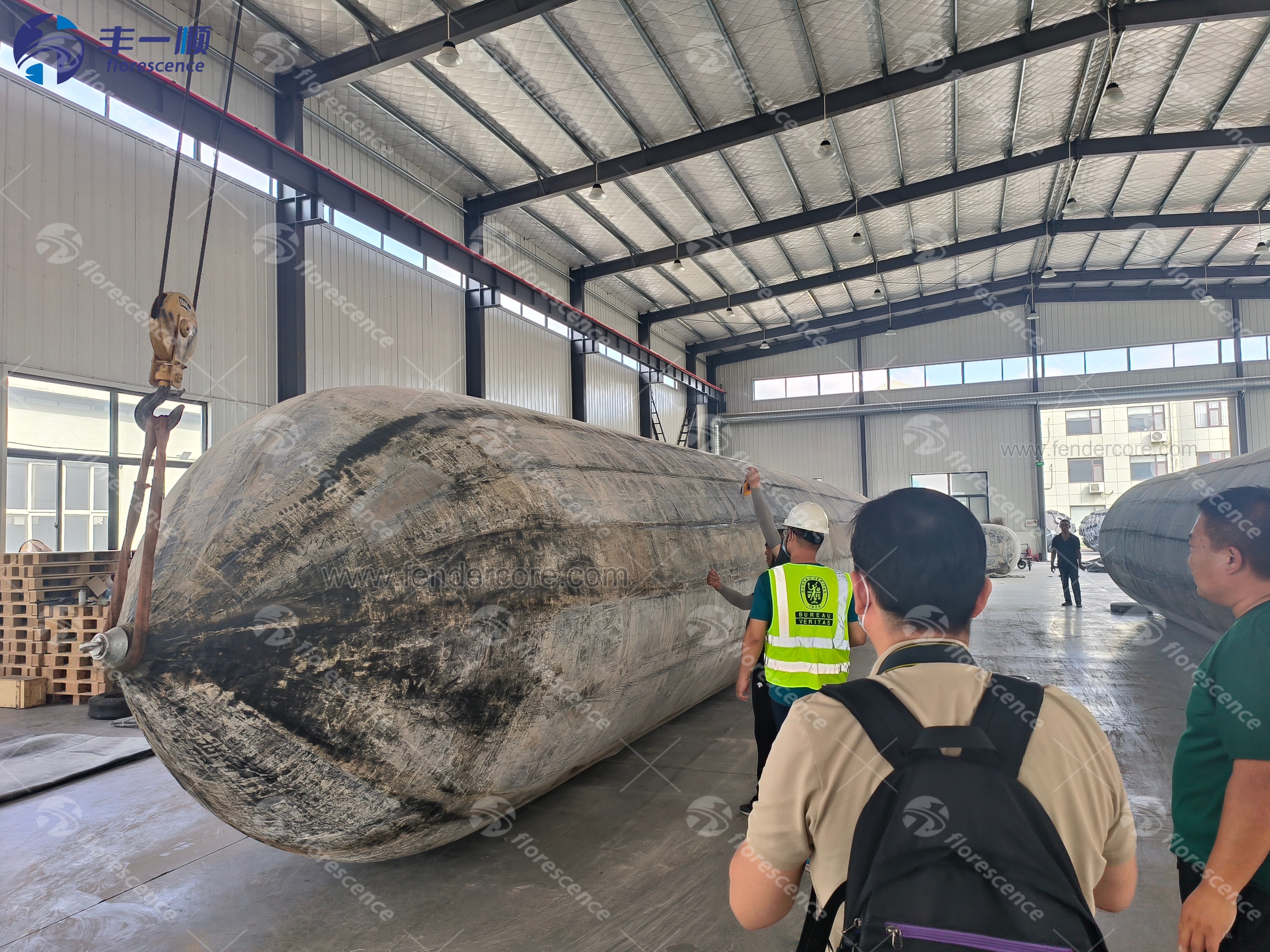
For a 1,000-ton launch, the practical acceptance file has five items: the ISO 14409 conformity statement, the classification certificate required by the project (BV, CCS, ABS or RS), the batch air-tightness and dimensional records, the third-party inspection report if one was ordered, and the QIR photographs of the units actually being shipped.
Step-by-Step: Running the 1,000-Ton Launch
Florescence publishes the operating sequence as seven stages: pre-launch preparation, basic equipment, crew preparation, rigging arrangements, block removal, forward movement and ship launching. The application data extends this into a five-stage mechanical cycle that ends with retrieval. Combined, they form the working checklist below.
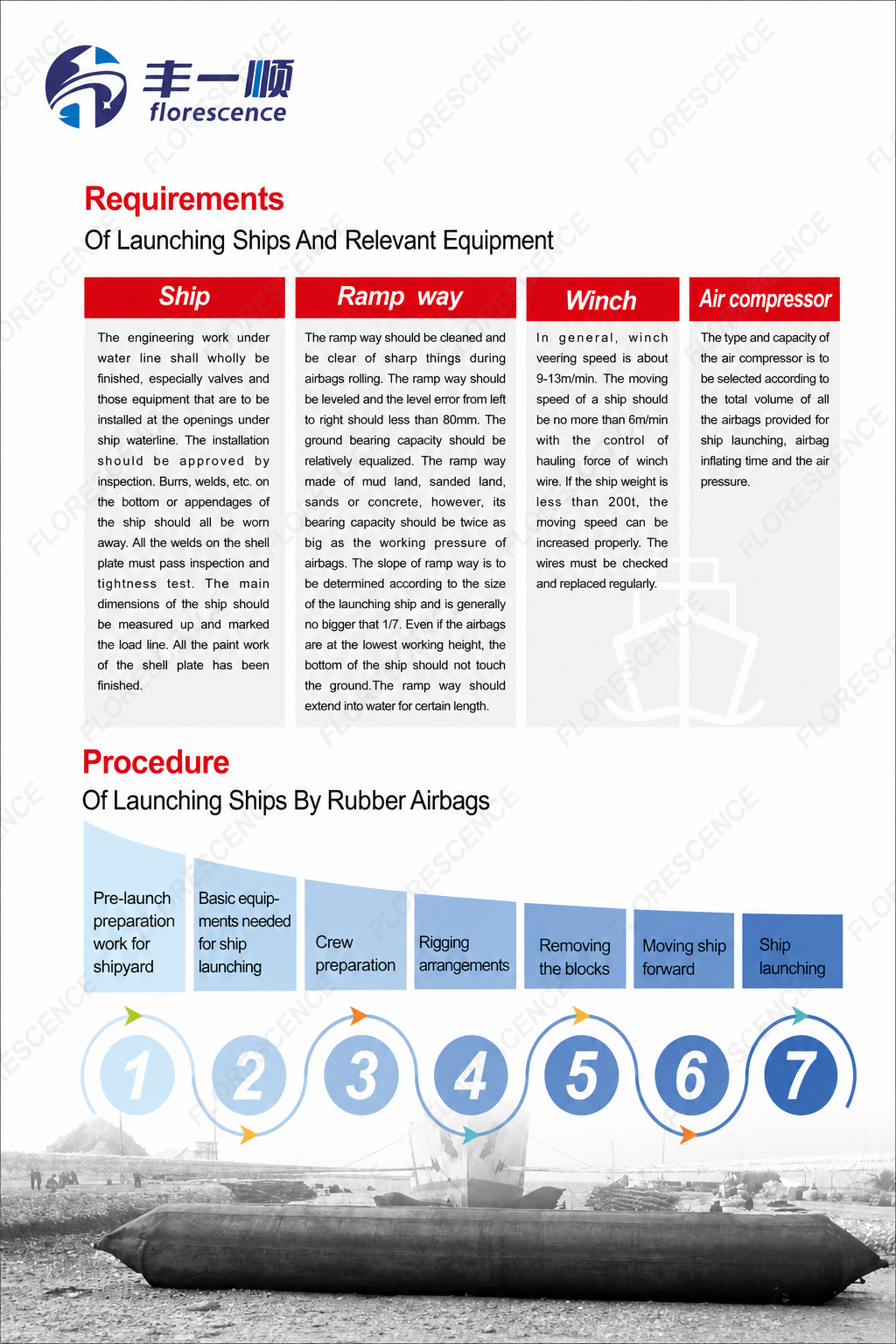
Step 1: Define the vessel and let the airbag set be calculated
Record length, beam, weight, hull form and the intended launch position. Florescence recommends airbag size and quantity from the vessel length, width and weight, and diameter, length, pressure rating, reinforcement layers and end structure can all be customized. Decide the layer count at this stage, because 3 to 12 layers is the range and the choice follows the working pressure the project requires.
Step 2: Prepare the slipway and the auxiliary equipment
The slipway should be ground or cement concrete, selected according to the tonnage of the vessel. Clear the slipway and the hull of sharp objects and keep both smooth and clean, because a puncture at this stage is not repairable on the slope. Prepare the auxiliary equipment: air compressor, rubber hoses, winch and ropes, with an excavator where the site plan calls for one.
Step 3: Brief the crew and arrange the rigging
Assign the pressure-check role and the winch-release role separately, and confirm the communication method between the slipway, the winch operator and the vessel. Rigging arrangements should be completed and checked before any airbag is inflated, not during inflation.
Step 4: Position the airbags under the hull
Unroll and lay the deflated airbags flat underneath the hull according to the pre-calculated spacing plan. Positioning is the step where the sizing work either holds or fails, so the plan should show bag positions rather than a total count.
Step 5: Inflate and verify pressure
Connect the pneumatic hose, open the air valve and inflate to the specified working pressure to lift the vessel off its support blocks. Confirm each reading on the gauge. Over-pressure is forbidden, and the pressure check is the point at which the vessel is either safely supported or the operation stops.
Step 6: Remove the blocks
Remove keel blocks, wooden supports and launching cradles only once the vessel is fully supported by the inflated airbags. Removing blocks early is the most common way a controlled launch becomes an uncontrolled one.
Step 7: Release the winch and roll the vessel
Release the holding winch system. Gravity and momentum allow the vessel to roll smoothly into the water on the rotating airbags. Watch the length direction during rolling: distortion is one of the four safety boundaries Florescence specifies, together with avoiding an overweight load after air charging.
Step 8: Retrieve, inspect and store
After the vessel floats free, collect the airbags from the water, open the release valves to deflate them completely, then clean and fold them. Store the set in a dry, ventilated place away from sunlight, oils, acids and sharp objects. With a published service life of 5 to 8 years, storage discipline is what determines whether the second and third launch use the same set.
- Strictly control operating pressure. Over-pressure is forbidden.
- The slipway should be ground or cement concrete, according to the vessel tonnage.
- No sharp objects on the slipway or the hull, which must stay smooth and clean.
- Avoid distortion in the length direction during rolling, and avoid overweight load after air charging.
Use Cases in the Same Project Family
A 1,000-ton launch is one scenario inside a wider operating envelope. The same airbag set covers several project types, and knowing which one applies changes the specification conversation.
- Series barge and vessel launching. A Brazilian shipyard used 13 units of D2.5 m × L15 m, 7-layer marine launching airbags to launch 13 barges, completing the work without operational delays or hull damage, with zero air leakage reported. The large-diameter design was selected for higher ground clearance and smoother rolling efficiency on the barges.
- Ship landing and dry docking. The same airbags are used for ship landing and docking work in shipyards and dry docks, not only for new-build launches.
- Heavy structure movement on land. Florescence lists hoisting and transporting heavy goods of up to 10,000 tonnes on land as an airbag application, alongside vessel movement and upgrading.
- Salvage and refloating. A marine salvage company in Romania used 10 units for shallow and deep-water boat salvage and sunken vessel refloating, with a stated 6 to 8 year service expectation under regular salvage and heavy-lifting conditions.
- Caisson and low-water-season launching. Where water level is insufficient, salvage airbags support a vessel launch up to 5,000 tons or a caisson launch up to 8,000 tons.
Specification Comparison: Launching Airbag vs Salvage Airbag
Both products share a manufacturing platform, and that is exactly why they are easy to confuse in a quotation. The table below compares the published specifications so a project buyer can see which line item belongs in the launch plan and which belongs in the contingency plan.
| Parameter | Ship Launching Airbag | Marine Salvage Airbag |
|---|---|---|
| Primary function | Ship launching, landing and docking, vessel movement and upgrading | Buoyancy assistance, refloating, salvage lifting and support for floating structures |
| Material | Natural rubber and nylon cord | Natural rubber and nylon cord |
| Layer range | 3 to 12 layers | 3 to 12 layers |
| Size range | Diameter 0.6 to 2.8 m, length 5.0 to 25 m | Diameter 0.6 to 2.8 m, length 5.0 to 25 m |
| Service life | 5 to 8 years | 5 to 8 years |
| Certificates | CCS, BV, ISO, RS, ABS | CCS, BV, ISO, RS, ABS |
| Standard fittings | Valve, pressure gauge, pulling ring, three-way connecting tube, hose joint | Inflation valve, pressure gauge, pulling ring, plus rubber handles and nylon rope net |
| Published performance note | Launch and upgrade capability up to 100,000 DWT; manufactured to ISO 14409 | Maximum working pressure 0.25 MPa, usable to 25 m water depth; 10 to 50 tons buoyancy per piece; supports vessel launch up to 5,000 tons or caisson launch up to 8,000 tons in low water season |
| Role in a 1,000-ton project | Main launching set under the hull | Recovery, refloating or low-water buoyancy contingency |
| Checkpoint | What to confirm | Basis |
|---|---|---|
| Dimensional and hardness | Batch records match the ordered diameter, length and layer count | Florescence batch inspection |
| Air-tightness | No leakage under test for every airbag in the set | Florescence batch inspection |
| Standard conformity | ISO 14409 conformity declared, with QP or QG class identified | ISO 14409:2011 |
| Classification | CCS, BV, ABS or RS certificate as required by the project | Classification society |
| Third-party inspection | SGS, BV or LR witness report if one was ordered | Third-party agency |
| Metal part traceability | EN 10204 3.1 mill certificates | Florescence documentation |
| Rubber properties | Tensile strength, elongation and compression report | Florescence documentation |
| Final release | Quality Inspection Report with test data and product photographs before shipment | Florescence QIR |
Frequently Asked Questions
What certification should a 1,000-ton ship launching project require from an airbag supplier?
ISO 14409:2011 is the standard for ship launching air bags and classifies marine airbags as Ordinary (QP) or High-capacity (QG), so the supplier should declare the class and provide conformity. Florescence manufactures its ship launching airbags to ISO 14409 and can supply CCS, BV, ISO, RS and ABS certificates depending on project requirement. The factory operates to ISO 9001, and every batch is air-tightness tested, dimensionally checked and hardness tested. Third-party inspection by SGS, Bureau Veritas or LR can be arranged, and EN 10204 3.1 mill certificates plus tensile strength, elongation and compression reports are issued for metal and rubber components. A Quality Inspection Report is issued before shipment.
Can standard ship launching airbags handle a 1,000-ton vessel, and how are size and quantity decided?
Florescence publishes a launch and upgrade capability of up to 100,000 DWT for its ship launching airbags, with 3 to 12 layers and a size range of 0.6 to 2.8 m diameter and 5.0 to 25 m length. Bearing capacity depends on airbag diameter, working pressure, contact area, vessel weight and the number of airbags used, so the set is calculated rather than picked from a page: the manufacturer recommends size and quantity from the vessel length, width and weight. Diameter, length, pressure rating, reinforcement layers and end structure can all be customized to the project.
What drives the cost of a 1,000-ton airbag launch?
Cost is driven by the airbag set rather than by the vessel alone. The variables are diameter, length and layer count within the 3 to 12 layer range, the number of units, the fitting package and whether repair kits are included, customization such as pressure rating, logo, package and drawing-based solution, and the scope of third-party inspection. Florescence positions airbag launching as a lower investment route than a fixed launching facility, with reusable bags, little maintenance, and no requirement beyond air compressors, winches and ropes. Minimum order quantity is 1 unit, so a single trial unit can be ordered before committing to a full set.
Can we inspect or trial a unit before committing to the full set?
Yes. The minimum order quantity is 1 unit, so a single trial unit can be ordered. Each batch goes through raw material testing, dimensional and hardness checks and air-tightness testing, and third-party inspection by SGS, BV or LR is accepted. Before shipment Florescence issues a Quality Inspection Report with rubber test data, sizing sheets and product photographs, and ships only after buyer approval. Free fittings, repair kits and on-site instruction are supplied with the order, and after-sales support covers 24/7 online technical support, installation, use and repair guidance, global on-site service and a 12 to 24 month warranty.
What lead time and logistics should we plan for a 1,000-ton launch?
Florescence quotes a lead time of 5 to 30 days with a monthly capacity of 200 units, and standard production is usually about 25 to 30 days depending on product type, quantity, customization requirements and shipping schedule. Airbags are shipped deflated to reduce freight cost, and sea freight, air freight, LCL and FCL are all supported with export packaging and full customs documentation. For a launch project, fix the launch window first and work backwards through inspection, packing and shipping. Send the vessel length, width and weight to inquiry@fendercore.com or WhatsApp +86 182-0532-1693 to receive a sized recommendation and quotation for the set.
Conclusion
A 1,000-ton airbag launch succeeds on preparation rather than on hardware volume. The airbag set has to be calculated from the vessel, the layer count has to follow the working pressure, the pressure has to be verified on a gauge before any block is removed, and the slipway has to be clean, concrete or ground, and free of sharp objects. Retrieval and storage then decide whether the same set carries the next vessel.
Qingdao Florescence Marine Supply Co., Ltd has manufactured marine rubber products since 1992, with a 40,000 m² factory, 120 employees, an annual output of 2,000 pieces, 25 engineers and exports to 95% of its markets across Southeast Asia, South America, Europe, North America, the Middle East and Africa. Its ship launching and salvage airbags are manufactured to ISO 14409, can be certified to CCS, BV, ISO, RS and ABS, and are supported by technical selection, third-party inspection, spare kits and on-site guidance for launch projects.
Plan Your 1,000-Ton Launch
Send the vessel length, beam, weight and planned launch date, and Florescence will return a recommended airbag size, layer count and quantity for the project, together with certification options and lead time.
Qingdao Florescence Marine Supply Co., Ltd · established 1992 · 40,000 m² factory · 25 engineers · ISO 9001 · ISO 14409 ship launching airbags · CCS, BV, ISO, RS, ABS certificates
Download the Florescence Catalogue WhatsApp +86 182-0532-1693 inquiry@fendercore.comWebsite: www.fendercore.com · Address: 27th Floor, 10-2 Building, Optical Valley Software Park, Emeishan Road No. 396, Qingdao, China.
Have Questions or Need More Details?
Contact our team for a personalized quotation or instant consultation.
Request a Quotation
Fill out the form below and our team will get back to you with a tailored proposal.
WhatsApp Direct Chat
Prefer to chat in real-time? Message us on WhatsApp for instant assistance & quick answers.
- Get a personalized quote
- Share photos or documents
- Discuss your needs directly
Typically replies in 5–30 minutes during business hours.