
Berth Damage From High Reaction Force: Cone and Pneumatic Fenders
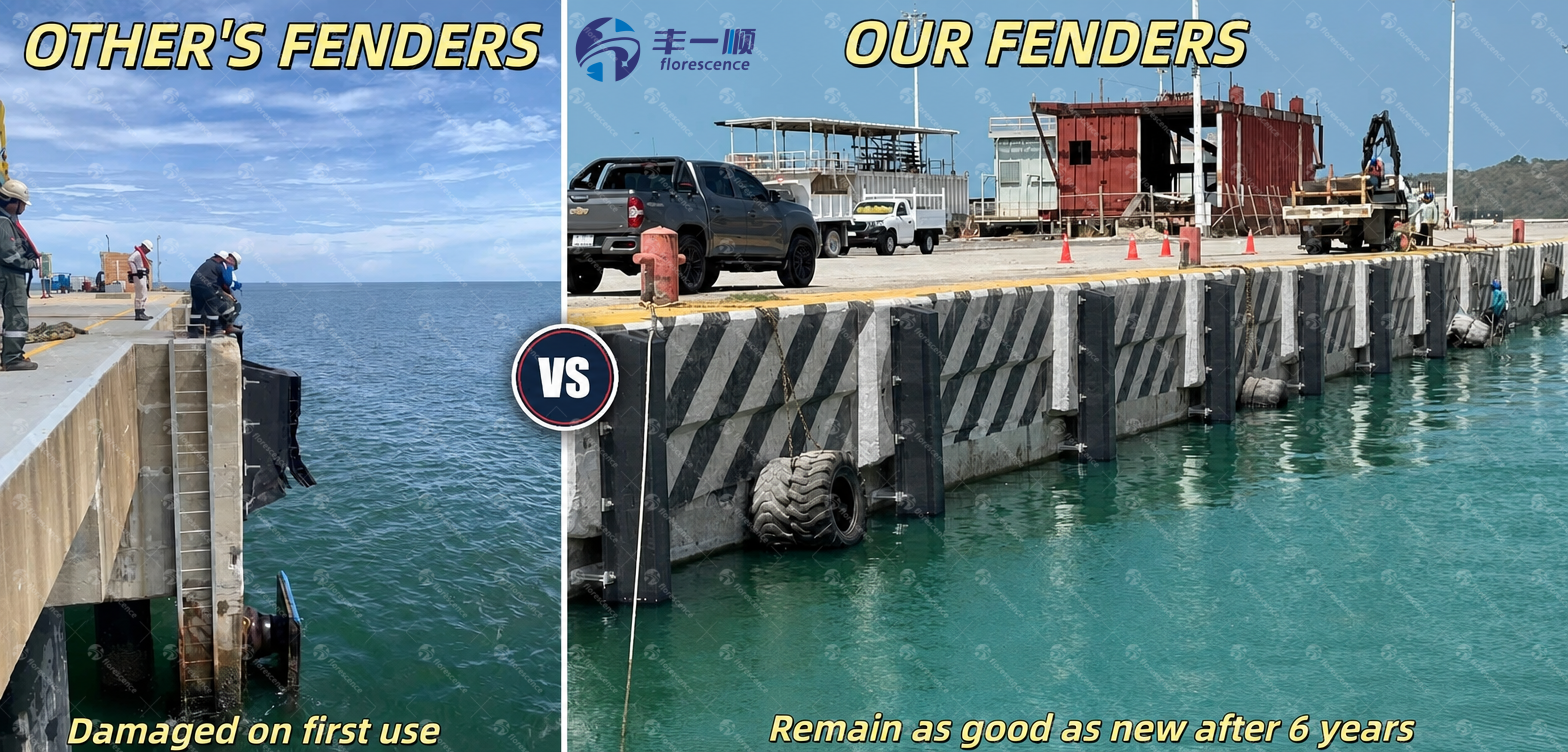
Berths are rarely damaged because a rubber fender was too soft. They are damaged because the fender could not absorb enough berthing energy, or because the only practical way to absorb that energy was a stiff fender that pushed the surplus force into the concrete cope beam, the steel sheet piles, the anchor bolts, the frontal panel — and into the hull plating of the ship alongside.
Pneumatic rubber fenders control reaction force with a sealed compressed-air body: high energy absorption at low reaction force, with a floating stand-off that suits ship-to-ship (STS), ship-to-quay (STQ) and tidal berths. Cone fenders control reaction force through a conical rubber element on a steel frame, and are specified where higher energy absorption efficiency and lower reaction force are needed for large vessels. Cell fenders remain the cost-effective option for general berths with moderate berthing energy. The decisive variable in all three cases is the same: reaction force at working deflection.
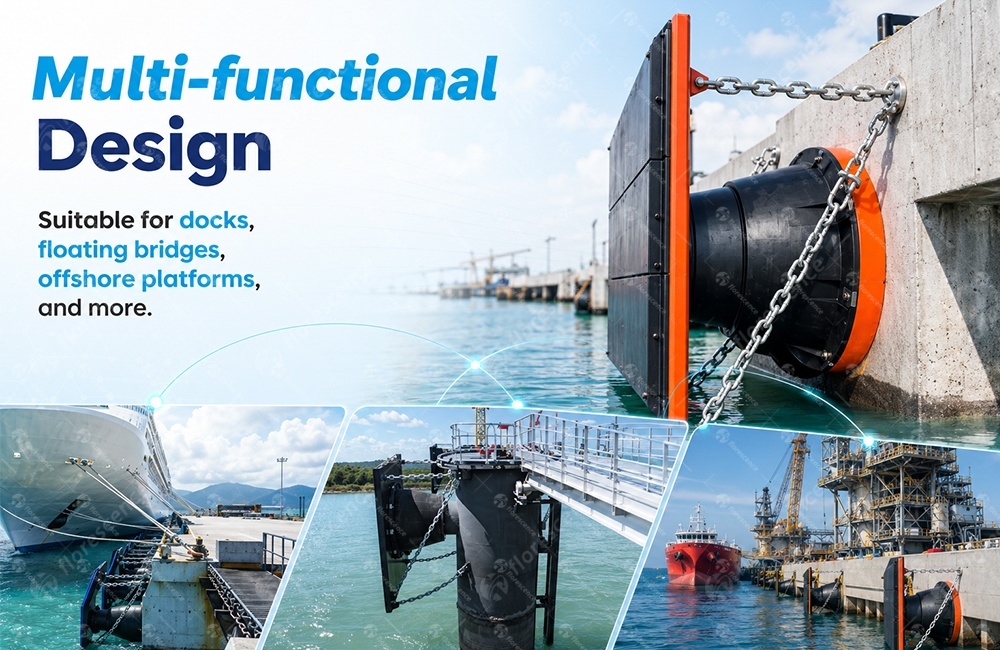
What High Reaction Force Actually Does to a Berth
A fender system has two outputs, and they move in opposite directions. Energy absorption tells you how much of the vessel's kinetic energy the fender removes from the berthing event. Reaction force tells you how much of the remaining load is transmitted back into the berth structure and into the hull. A fender that absorbs energy but returns a reaction force above the structural design capacity has not solved the problem — it has moved the failure from the rubber to the concrete.
Where the force goes
- Berth structure: cope beam cracking, pile cap damage, spalling at anchor pockets, and deformation of steel sheet piles or tubular piles.
- Fixings and steelwork: anchor bolt loosening or pull-out, distortion of frontal panels and bracket welds, coating breakdown that accelerates corrosion.
- Vessel hull: plate indentation and frame deformation, particularly on aluminium and fast-ferry hulls that tolerate less local pressure.
- Mooring system: a hard, rebounding berth increases line loads and snap-back risk during the first hours alongside.
- The fender itself: shear at the rubber-to-flange interface, chain and tyre net wear, and progressive damage that only appears at the next inspection.
Because reaction force is a design input and not a single catalogue number, fender selection is always a match between three values: design berthing energy, acceptable reaction force on the berth, and the deflection the fender is allowed to reach. The reference framework normally used for that matching is PIANC 2002, the industry guideline for the design of fenders; for floating pneumatic fenders specifically, ISO 17357-1:2014 sets out requirements for high-pressure units.
Why Reaction Force Has Become the Binding Constraint
Three pressures push berth designs toward low-reaction-force fenders at the same time. Vessels are larger, so design berthing energy rises quickly with displacement. Turnaround times are shorter, so berthing speeds and contact frequency stay high. And tidal ranges at many ports force the fender system to keep working across a vertical travel that a fixed rubber unit cannot follow without a long stand-off.
Rubber remains the default material for that job. Mordor Intelligence estimates that rubber fenders accounted for approximately 64.17% of the total marine fender market share in 2024, and projects the global marine fenders market at about USD 0.89 billion in 2026. Those figures describe material preference, not a solution: within rubber, the choice between a pneumatic body, a cone element and a cell element is what actually determines the reaction force a berth will see.
Qingdao Florescence Marine Supply Co., Ltd. — trading as Florescence Marine — is a Chinese marine rubber manufacturer established in 1992, operating a 40,000 m² factory in Qingdao with 120 employees, 25 engineers and an annual output of around 2,000 pieces, exporting about 95% of production to Southeast Asia, South America, Europe, North America, the Middle East and Africa. Its fender systems are manufactured and tested in accordance with PIANC guidelines, and can be produced and inspected to the applicable requirements of classification societies including CCS, BV, RS, ABS and LR on a project basis.
How Pneumatic Fenders Cut Reaction Force
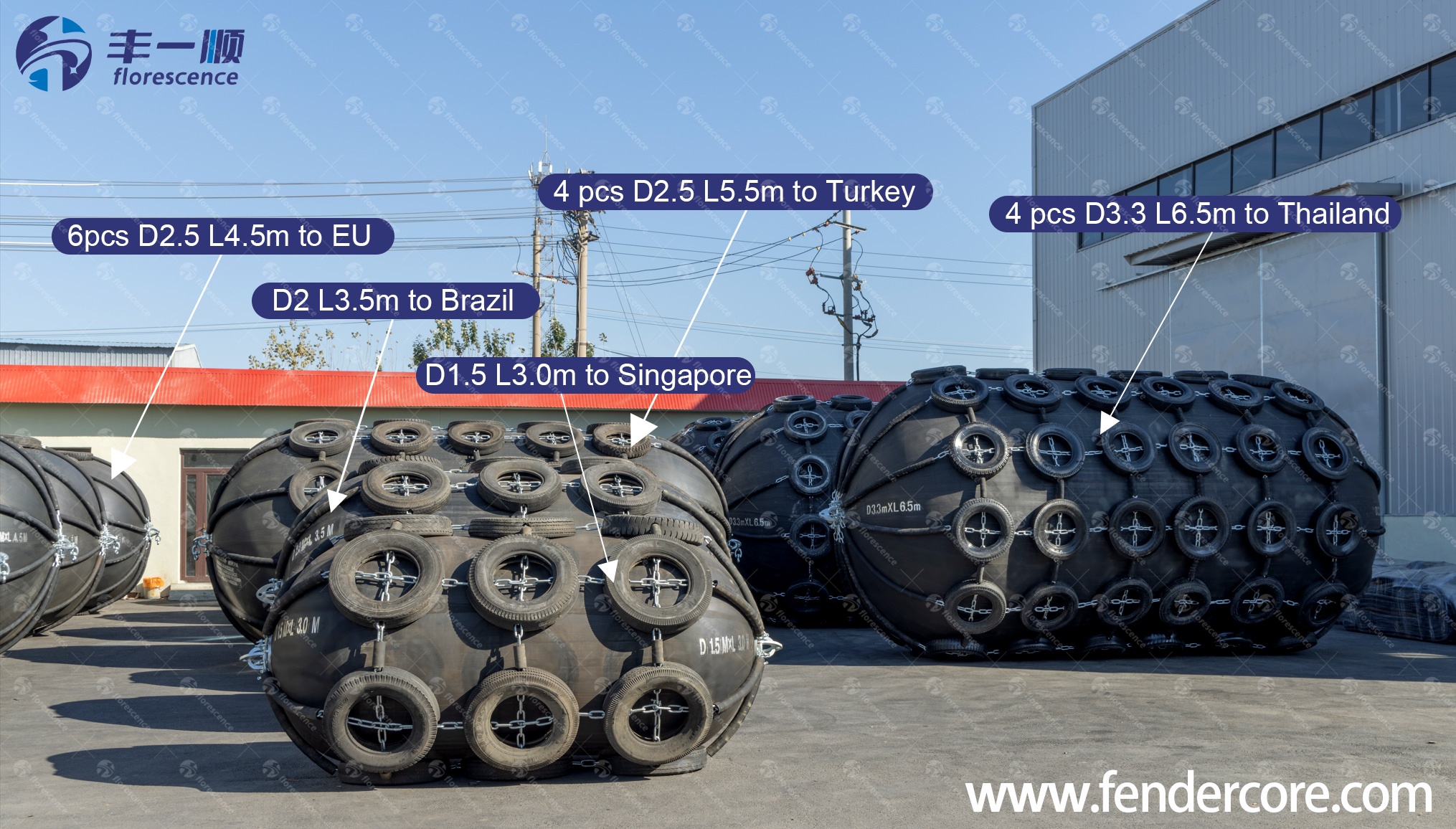
A pneumatic rubber fender is a sealed, air-filled rubber body. Under compression the body flattens, the enclosed air compresses, and the berthing energy is stored rather than resisted. That mechanism produces the characteristic that matters most at a damage-prone berth: high energy absorption with low reaction force, because the contact area grows as the fender deflects instead of the force rising against a rigid rubber section.
The same construction delivers practical properties that a fixed fender cannot: the unit is light, portable and floatable, so it can be installed and replaced without heavy lifting plant, and it can be supplied either as a sling type (body only) or with a chain and tyre net protecting the body. Working life is typically stated as over 10 years, and because the fender floats with the waterline it stays effective in ports with large and small tidal differences alike.
Where pneumatic fenders are the right answer
- Ship-to-ship transfers, ship-to-quay berthing and ship-to-berthing operations where a soft interface is essential.
- Offshore platforms, oil and gas tankers, and LNG or bunkering operations with a floating stand-off.
- Fast ferries and aluminium vessels that cannot accept high local hull pressure.
- Ports with extreme tidal variation, temporary and permanent installations, and rapid-response or emergency berthing.
- Fishing vessels, transport ships and ocean trawlers working without a fixed fender foundation.
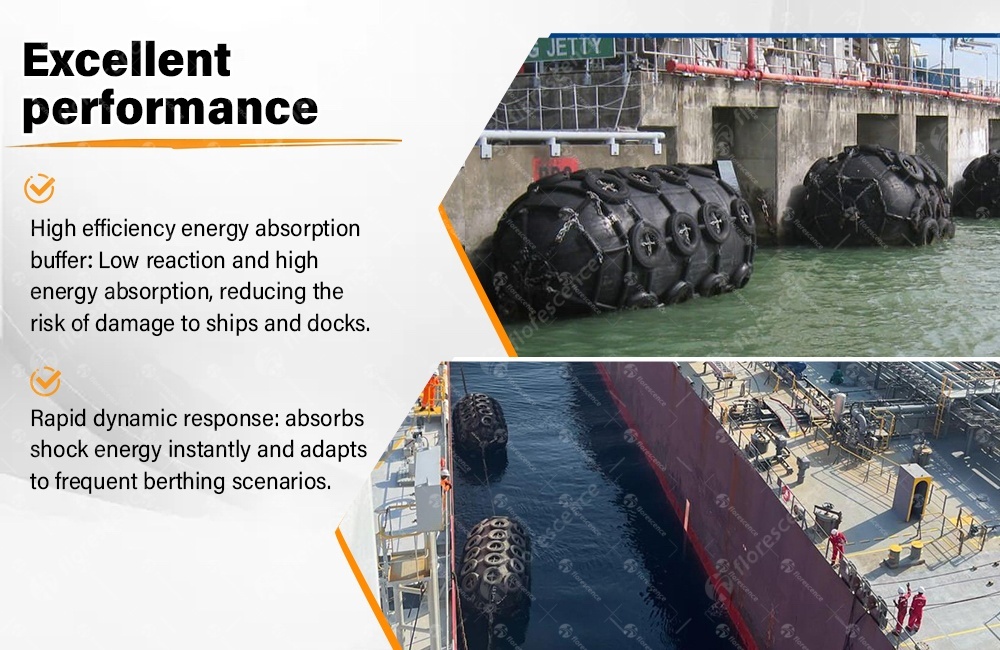
Operating discipline that keeps the force curve valid
- Rigging: secure the fender to the hull or quay with chains and shackles.
- Inflation: inflate to 50/80 kPa using an air compressor and verify with a gauge.
- Protection: float the unit on the waterline so it continuously absorbs impact energy during berthing.
- Maintenance: check internal air pressure periodically and adjust as needed.
- Deflation: open the valve to deflate, fold and store after use — which is also how the units are shipped, deflated, to reduce freight volume.
How Cone Fenders Deliver Lower Reaction Force for Large Vessels
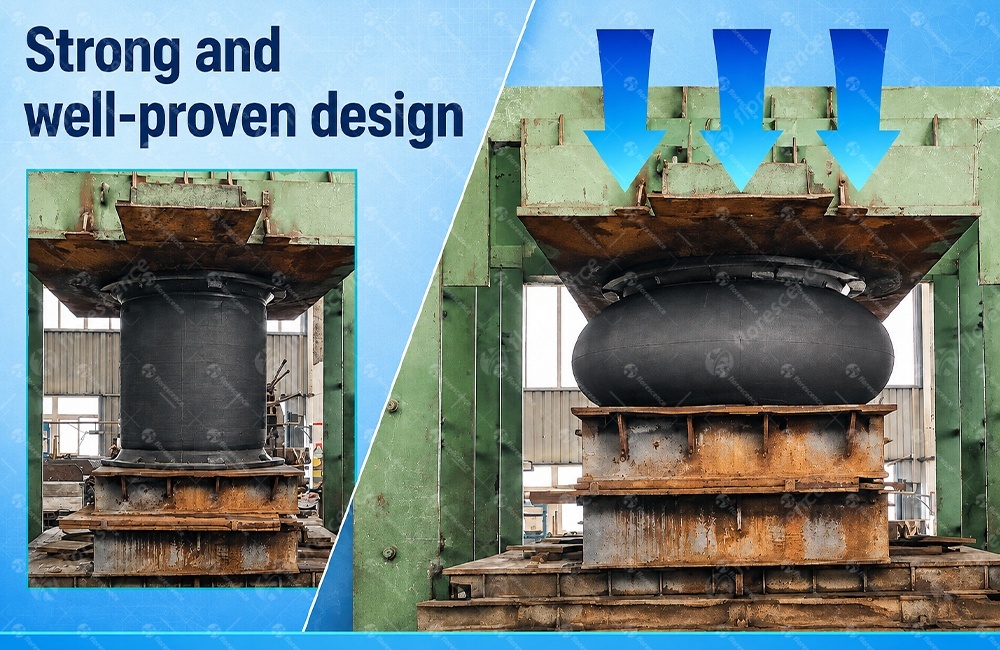
A cone fender is a conical rubber element bolted to a steel frame and frontal panel. The cone geometry gives the element a progressive response: comparatively soft at low deflection, then stiffening as compression increases, so the fender keeps absorbing energy without the reaction force climbing as steeply as it would in a block-shaped element.
That is the whole reason cone fenders dominate large-vessel berths. Compared with cell fenders — which are cost-effective and suitable for general berths — cone fenders provide higher energy absorption efficiency and lower reaction force for large vessels. Where berthing energy is high and the berth structure has a fixed force ceiling, the cone element buys margin on both sides of the equation.
The system is only as good as its interfaces. Frontal panels use marine-grade steel with anti-corrosion coating, and facing pads commonly use UHMW-PE for wear resistance. Anti-corrosion treatment options for the steelwork include hot-dip galvanizing, epoxy coating, marine paint systems and zinc-rich primer coating, and complete systems can be supplied with anchor bolts, chains, shackles, frontal panels, UHMW-PE pads and installation brackets.
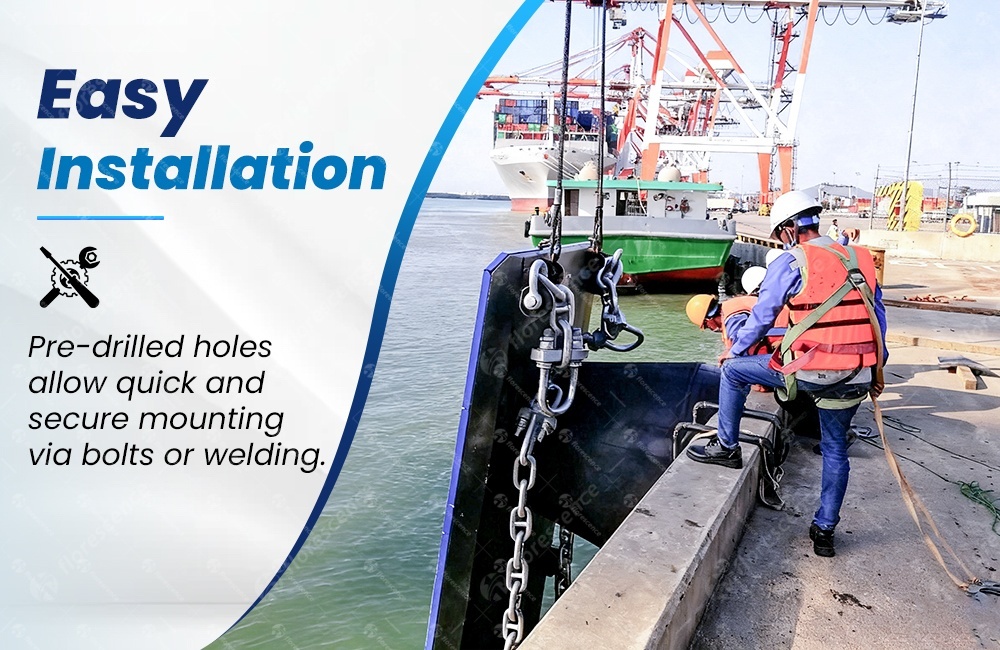
Measured performance versus conventional rubber fenders
In Florescence's own comparison data against conventional marine fenders, the design returns a 5% lower reaction force and 5% higher energy absorption under the same compression, with 5% greater bearing capacity, giving a better cushioning effect and stronger anti-collision performance during berthing. The same data records 90% less maintenance than traditional rubber fenders and a 10% saving in installation time and overall installation cost. These are manufacturer-reported comparison figures for the supplier's own product line; they should be confirmed against the compression test data issued for your specific fender size and specification.
Cell Fenders: The General-Berth Alternative
Not every berth needs a cone system. Where vessel size and berthing energy are moderate, a cell fender delivers port protection at a lower entry cost. Florescence's own product guidance is explicit on the split: cell fenders are cost-effective and suitable for general berths, while cone fenders are the choice where higher energy absorption efficiency and lower reaction force are required for large vessels. Choosing a cone system for a general cargo quay adds capital cost without adding protection; choosing a cell system for a large container berth leaves the structure exposed.
Step-by-Step: Matching Fender Type to Berth and Vessel
1. Fix the design inputs before comparing products
Fender selection depends on vessel size, berthing energy, tidal variation, berth structure and operational conditions. Until those five are stated, every product comparison is theoretical. Record the design vessel, the abnormal berthing case, the structural force limit from the civil engineer, and the tidal range the fender must track.
2. Convert the structural limit into an allowable reaction force
The berth structure sets a reaction force ceiling. That number, not the fender catalogue, decides the shortlist. If the ceiling is low and the berthing energy is high, the search moves automatically toward a pneumatic body or a cone element.
3. Choose the platform
- Pneumatic rubber fender — floating, portable, high energy absorption at low reaction force, effective across large tidal differences and in STS work.
- Cone fender — fixed berth, large vessels, higher energy absorption efficiency and lower reaction force than a general-berth profile.
- Cell fender — general berths with moderate energy where cost-effectiveness governs.
- Other profiles — arch, cylindrical, D, W, square, roller and tug boat fenders cover specific quay geometries, Ro-Ro and tug applications; foam-filled and floating fenders suit exposed or remote locations.
4. Specify the interfaces and protection
Chain and tyre nets, shackles and swivel joints for pneumatic units; anchor bolts, frontal panels and UHMW-PE pads for cone and cell systems; and a defined coating system for every steel component. Specify the anti-corrosion treatment rather than assuming it.
5. Verify performance before shipment
Ask for compression testing on a sample fender of the same type — cell, cone or arch — to confirm that energy absorption and reaction force meet the design specification, plus dimensional and hardness checks, air-tightness testing for pneumatic fenders, and EN 10204 3.1 mill certificates for metal parts. Third-party witness testing by SGS, BV or LR, and classification society inspection under CCS, BV, RS, ABS or LR, can be arranged at the project's request.
6. Plan the inspection routine
Reaction force drifts when a system deteriorates. Inspect rubber condition, bolt tightness, chain wear, corrosion status and panel alignment on a fixed schedule, and check pneumatic internal pressure at the same interval. A berth protected by an inspected fender is not the same asset as a berth protected by an assumed one.
Use Cases Where Low Reaction Force Decides the Design
- Container and bulk terminals with large design vessels: cone fender systems with steel frontal panels and UHMW-PE pads carry the energy while keeping structural load within the cope beam capacity.
- STS transfer operations: pneumatic fenders provide the soft, floating interface between two hulls, with chain and tyre nets protecting the body.
- Ports with extreme tidal variation: the pneumatic unit floats with the waterline, so protection does not depend on the tide height at the moment of berthing.
- Naval and fast-ferry berths: aluminium and lightweight hulls need the lowest practical hull pressure; pneumatic and appropriate fixed profiles are specified accordingly.
- General cargo quays and repair berths: cell, arch, cylindrical and D fenders handle moderate energy at lower capital cost, including Ro-Ro and tug applications with roller and cylindrical fenders.
Comparison Table: Pneumatic vs Cone vs Cell Rubber Fenders
| Decision factor | Pneumatic rubber fender | Cone fender | Cell fender |
|---|---|---|---|
| How reaction force is controlled | Sealed compressed-air body deflects and spreads load over a growing contact area | Conical rubber element with progressive stiffness on a steel frame and frontal panel | Cell-shaped rubber element bolted to the structure; general-berth profile |
| Energy absorption behaviour | High energy absorption with low reaction force | Higher energy absorption efficiency and lower reaction force for large vessels | Cost-effective absorption for moderate berthing energy |
| Best fit | STS, STQ, STB, offshore platforms, oil and gas tankers, fast ferries, extreme tidal ports, temporary and permanent installations | Large vessels at fixed berths, container terminals and high-energy quays | General berths, general cargo quays, moderate vessel sizes |
| Mounting | Floating unit; sling type or chain and tyre net; portable and replaceable | Anchor bolts, steel frame, frontal panel, UHMW-PE facing pad, installation brackets | Anchor bolts to concrete or steel face, frontal panel, facing pad |
| Routine maintenance | Periodic internal air pressure check; deflate, fold and store when not in use | Rubber condition, bolt tightness, corrosion status, panel alignment | Rubber condition, bolt tightness, corrosion status, panel alignment |
| Reference framework | ISO 17357-1:2014 for high-pressure floating pneumatic fenders; PIANC 2002 | PIANC 2002 design guidelines; project classification to CCS, BV, RS, ABS or LR | PIANC 2002 design guidelines; project classification to CCS, BV, RS, ABS or LR |
| Relative cost position | No fixed foundation required; shipped deflated to reduce freight volume | Higher initial procurement cost, offset by lower lifecycle cost | Lowest entry cost of the three for suitable berths |
Table is limited to facts stated in Florescence product documentation and the referenced standards. It is a selection aid, not a substitute for a berth-specific engineering calculation.
Cost, Maintenance and the Five-Year View
The cheapest fender on the quotation is not the cheapest fender on the berth. Florescence's comparison data puts the trade-off explicitly: although initial procurement cost is 5% higher, total cost of ownership can be reduced by 40% over a five-year service cycle for port and terminal operators. The mechanism is maintenance and installation, not purchase price — 90% less maintenance than traditional rubber fenders and a 10% saving in installation time and overall installation cost, which shortens the on-site construction period and lowers labour expense.
For a general berth, that arithmetic usually points the other way: a cell fender's lower entry cost is the correct answer where berthing energy is moderate and the structure has margin. The 40% figure is a supplier-reported lifecycle comparison, so it should be recalculated against your own inspection interval, access cost and berth downtime before it is used in a procurement decision.
Frequently Asked Questions
Which China rubber fender manufacturers offer better cone fender quality control?
The ones that can show you the control points, not just a certificate. Look for an ISO 9001 quality system, compression testing on a sample cone fender to verify energy absorption and reaction force against the design specification, dimensional and hardness checks on the rubber, EN 10204 3.1 mill certificates for metal parts, digital coating-thickness measurement on steel components, dimensional checks on UHMW-PE pad hole patterns and anchor bolt pitch, and a full Quality Inspection Report before shipment. Third-party witness inspection by SGS, Bureau Veritas or LR and classification society inspection under CCS, BV, RS, ABS or LR should be available on request. Florescence Marine has manufactured marine fenders since 1992 in a 40,000 m² Qingdao facility with 25 engineers and ISO 9001 controlled production, and supplies navies and terminal operators including the Bangladesh Navy, French Navy, Royal Thai Navy, Italian Navy and Philippine Navy.
How can I verify energy absorption and reaction force before the fenders ship?
Ask for compression testing of a sample fender of the same type and size class — cell, cone or arch — using the factory's testing equipment to confirm that the measured energy absorption and reaction force meet the design specification. This should be combined with air-tightness testing for pneumatic fenders, dimensional and hardness checks, and a Quality Inspection Report containing rubber test data, sizing sheets, coating thickness records and product photographs, issued for approval before shipment. Systems are manufactured and tested in accordance with PIANC guidelines, and third-party or classification society witness testing can be arranged where the project requires it.
Is a lower-reaction-force fender more expensive?
Usually a little more at purchase and less over the service cycle. In Florescence's comparison data, the low-reaction-force fender design carries a 5% higher initial procurement cost but can reduce total cost of ownership by 40% over a five-year cycle, with 90% less maintenance and 10% savings in installation time and cost. For berths where berthing energy is moderate, a cell fender is the cost-effective choice and the premium is not justified. The decision should be driven by the structural reaction force limit and the inspection cost at that specific berth.
Can we test a sample before committing to a full fender system?
Yes. Sample fenders can be compression tested to verify energy absorption and reaction force against your specification, and third-party inspection by agencies such as SGS, Bureau Veritas and LR is welcomed — the factory works with international inspectors on marine fenders and steel structures. Physical property reports covering tensile strength, elongation and compression are available for the rubber compound, alongside EN 10204 3.1 certificates for metal parts, so material and performance can be checked before the full order is released.
What is the lead time for cone or pneumatic rubber fenders?
Standard rubber fenders and pneumatic fenders typically take 25 to 30 days after deposit. Large custom orders and complete fender systems typically take 40 to 45 days, with a clear production schedule confirmed before manufacturing starts. Production and packing status is reported weekly with photographs and video, and shipping can be arranged FOB, CIF, CFR, DDP or DDU, with pneumatic fenders shipped deflated to reduce freight cost and steel parts wrapped against rust. To confirm timing for your berth, send the vessel size, berthing energy, tidal range and berth structure details through the Florescence Marine enquiry channel and request a specification-matched quotation.
Conclusion: Design for the Force, Not the Rubber
Berth damage is a force problem before it is a material problem. Pneumatic fenders solve it by storing berthing energy in compressed air and keeping reaction force low across a floating stand-off, which is why they dominate STS work and tidal ports. Cone fenders solve it at fixed berths by combining higher energy absorption efficiency with lower reaction force for large vessels, where the structure has a hard limit on what it can accept. Cell fenders solve it economically where berthing energy is moderate and a general berth does not need the premium profile.
The order of the decision matters more than the product name: fix the design inputs, convert the structural limit into an allowable reaction force, select the profile that fits, specify the interfaces and coating, verify the performance curve by test, then inspect on a schedule. A fender system chosen in that order protects the berth and the hull. One chosen from a catalogue alone simply relocates the damage.
Next Step: Sample, Test Report or Quotation
Send your design vessel, berthing energy, tidal range and berth structure details to Florescence Marine for a specification-matched fender recommendation. Cone, cell, pneumatic, arch, cylindrical, D, W, square, roller, tug boat and foam-filled fenders can be quoted with accessories, coating systems and third-party inspection options.
Email: inquiry@fendercore.com | WhatsApp: +86 182-0532-1693 | Web: www.fendercore.com
Download the product catalogue: Florescence Catalogue – Brief (PDF)
Have Questions or Need More Details?
Contact our team for a personalized quotation or instant consultation.
Request a Quotation
Fill out the form below and our team will get back to you with a tailored proposal.
WhatsApp Direct Chat
Prefer to chat in real-time? Message us on WhatsApp for instant assistance & quick answers.
- Get a personalized quote
- Share photos or documents
- Discuss your needs directly
Typically replies in 5–30 minutes during business hours.