
What Is a Pneumatic Rubber Fender? How Compressed Air Protects Ships in STS and STQ
A pneumatic rubber fender is a compressed-air-filled rubber body used as the protective medium between two vessels during ship-to-ship contact (STS), between a vessel and a quay during ship-to-quay berthing (STQ), and during ship-to-berthing (STB) operations. The energy-absorbing element is not the rubber itself — it is the air sealed inside it.
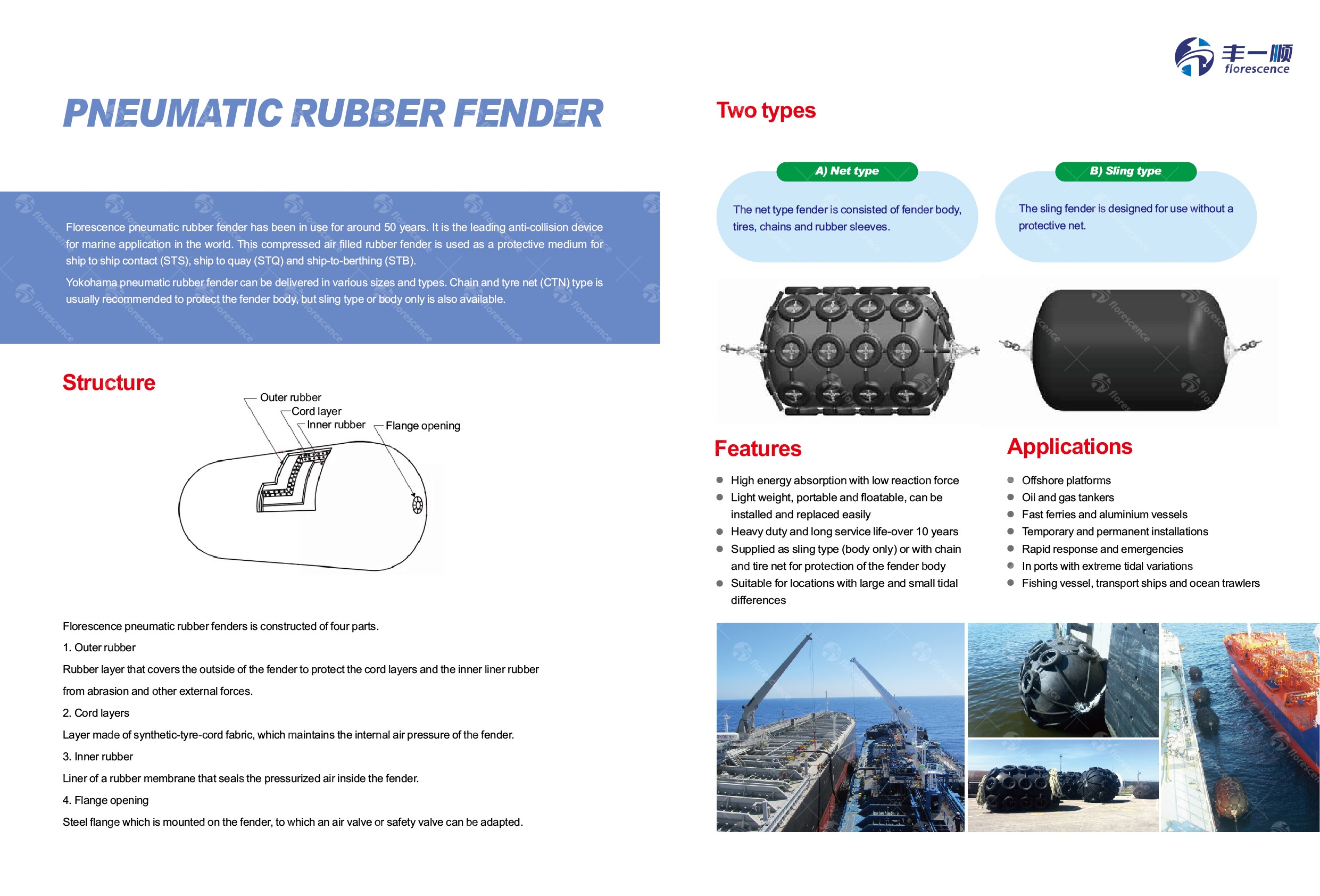
Cover: A Florescence Yokohama-type pneumatic rubber fender. The sealed air chamber, end flanges and towing ring are the parts that determine how the unit performs at the waterline.
That single structural fact explains most of what buyers, port engineers and marine superintendents need to know. Because air can be compressed and then released gradually, a pneumatic fender can absorb a large amount of berthing energy while keeping the peak reaction force it pushes back into the hull or the quay comparatively low. Pneumatic rubber fenders have been in use for around 50 years and are described in marine product literature as the leading anti-collision device for marine application worldwide.
This article explains the working principle in plain engineering terms, sets out the body configurations available, walks through installation and inflation step by step, and closes with the criteria buyers use when shortlisting recommended pneumatic rubber fender manufacturers for port protection projects.
Definition: What Exactly Counts as a Pneumatic Rubber Fender
The defining feature of a pneumatic rubber fender is a sealed internal air chamber enclosed by a reinforced rubber shell. The shell carries the pressure, resists abrasion against hull plating and concrete, and returns to its original geometry after each contact. Everything else — valves, flanges, towing rings, chains, tyre nets — is there to manage or protect that air chamber.
Two reference points anchor the category. The first is technical: ISO 17357-1:2014 specifies the requirements for high-pressure floating pneumatic rubber fenders, and it is the standard most specifications and classification society certificates reference. The second is commercial: in international trade, the product family sits under HS code 4016.94, the heading for boat or dock fenders of vulcanised non-cellular rubber, whether or not inflatable.
The pneumatic family is commonly supplied under the Yokohama designation and can be delivered in various sizes and types. Within that family, two body configurations dominate:
- Sling type (body only) — the bare fender with its end fittings, lifted and secured by slings or shackles.
- Chain and tyre net (CTN) — the same body wrapped in a chain-and-tyre net, usually recommended to protect the fender body where it will be handled roughly, towed, or repeatedly pulled against a hull.
Qingdao Florescence Marine Supply Co., Ltd., established in 1992, manufactures pneumatic rubber fenders as one of its core product lines alongside dock fenders, ship fenders, foam fenders and ship launching and salvage rubber airbags. The company operates a 40,000 m² factory with 120 employees and exports to Southeast Asia, South America, Europe, North America, the Middle East and Africa, with an export ratio of 95%.
The Problem It Solves: Berthing Energy Has to Go Somewhere
When a vessel approaches a berth or another vessel, it carries kinetic energy that does not disappear on contact. It has to be absorbed, stored and released, or it goes into structures that were never designed to take it — hull plating, fender panels, anchor bolts, quay walls. The stated function of a marine rubber fender system is to protect the hull and the berthing facility from damage when vessels berth alongside.
Three conditions make that function harder than the sentence suggests:
- Tidal range. The contact point between a vessel and a fixed structure moves vertically through the tide. A fender system that is efficient at one water level may be poorly engaged at another. Pneumatic fenders are described as suitable for locations with large and small tidal differences because the floating body rides the waterline.
- Inclined and angled contact. Vessels rarely arrive perfectly parallel. A fender has to work when the hull meets it at an angle, and the rubber body plus internal pressure has to redistribute that load rather than concentrate it.
- Double-sided motion. In STS transfer, both bodies are moving. The fender sits between two floating structures, and the shear and rolling loads it sees are different from a quay-mounted element bolted to concrete.
This is the specific gap that compressed-air fendering fills. A rigid element has to deform its own material to absorb energy. A pneumatic fender compresses a gas, which is a far more compliant medium, and then lets that gas expand again over a longer time window.
Industry Background: Fifty Years of Compressed Air at the Waterline
Pneumatic fendering is a mature category rather than a new technology. Pneumatic rubber fenders have been in use for around 50 years, and the reason they have stayed in service is that no other single configuration solves the tidal-range and inclined-berthing problem as directly.
The commercial weight of rubber fendering is also measurable. Rubber fenders accounted for approximately 64.17% of total marine fender market share in 2024, and the global marine fenders market is projected to reach USD 0.89 billion in 2026 according to Mordor Intelligence. Public supplier catalogues show how wide the resulting product taxonomy has become: cone, cell, element, arch, cylindrical, square, pneumatic, foam-filled, roller and donut fenders all appear in current listings from established suppliers such as ESC Marine Systems.
Within that taxonomy, pneumatic fenders occupy a specific slot. Fixed rubber elements — cone, cell, arch, cylindrical, D and W profiles — are mounted to a structure and stay there. Pneumatic fenders float, can be moved, can be deployed for a single operation and recovered afterwards, and can be installed on a vessel rather than on a quay. That portability is a design property, not an accessory.
How the Compressed Air Principle Actually Works
The mechanism runs in three phases, and understanding them is what allows a buyer to read a fender specification intelligently.
Phase 1 — Contact and initial deformation
The vessel's hull or the quay face meets the fender. At this point the internal air volume is still close to its design value, the shell begins to deflect, and most of the vessel's energy is still kinetic. The contact area starts small and grows quickly.
Phase 2 — Compression and energy storage
As the vessel continues to close, the fender flattens. The sealed air inside is compressed into a smaller volume, internal pressure rises, and the rubber shell stretches to contain it. Energy is now stored in two places at once: as compressed gas and as strain energy in the rubber. Because the gas is doing most of the work, the fender can deflect substantially without the reaction force rising as steeply as it would in a solid element of the same footprint.
This is the origin of the characteristic that appears in every pneumatic fender specification: high energy absorption with low reaction force. The two quantities are linked. A fender that absorbed the same energy with a higher reaction force would push more load into the hull and the berth structure.
Phase 3 — Recovery and release
As the vessel settles against the berth or moves away, the compressed air expands and returns the shell towards its original shape. Because the release happens over a longer period than the compression, the peak load transmitted to the structure is lower than the stored energy alone would suggest. The fender is then ready for the next contact without intervention.
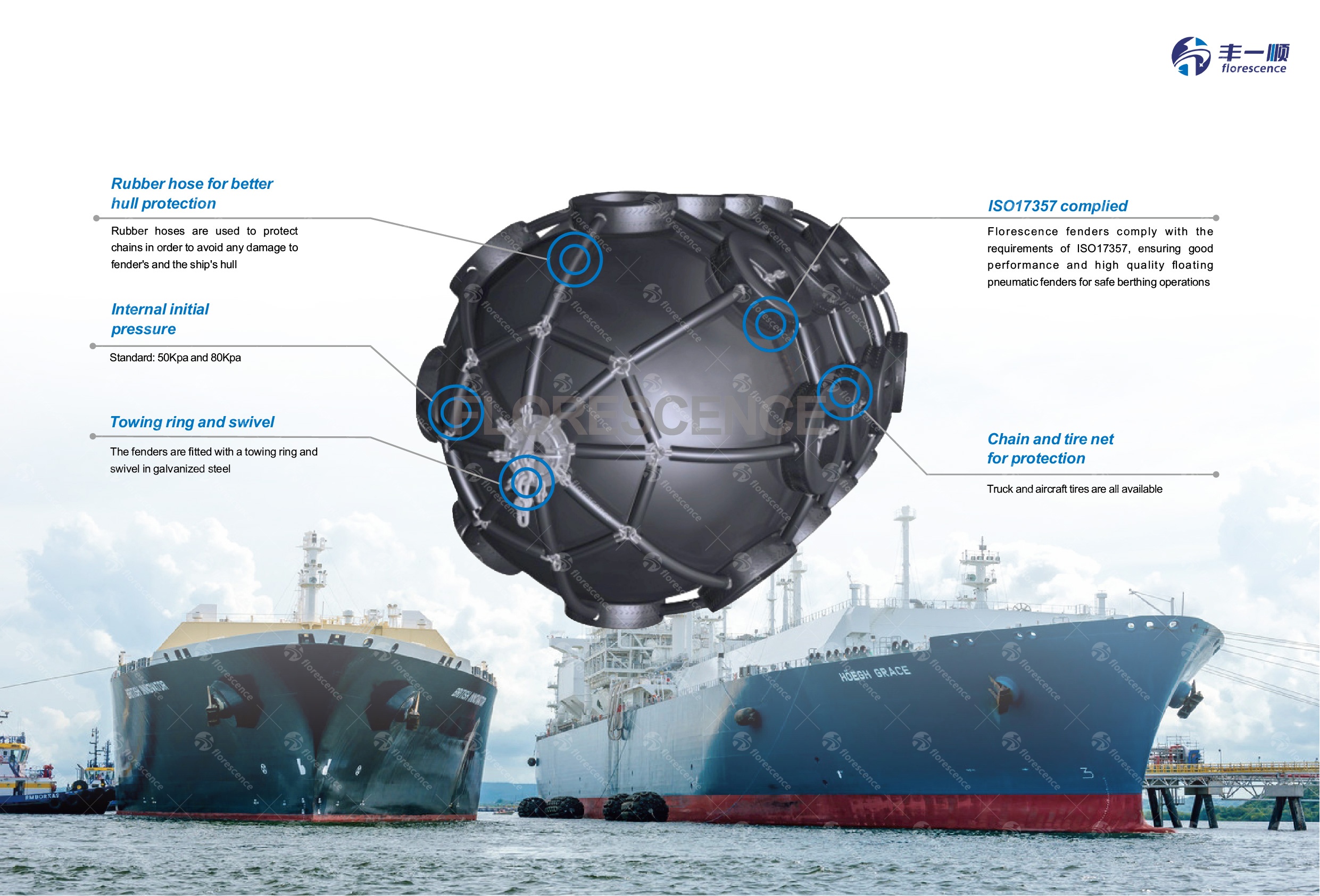
Supporting image: the fittings that make the principle work — inflation valve, end flange and towing ring on a Florescence pneumatic fender.
Operating pressure is the control lever. Florescence specifies inflation to 50 kPa or 80 kPa with an air compressor, verified against a pressure gauge, with internal air pressure checked periodically and adjusted as needed. Pressure selection is not a detail: it changes the stiffness of the air spring and therefore the balance between energy absorption and reaction force for a given berthing case.
Five Characteristics That Define the Category
Pneumatic rubber fenders are specified around five characteristics. Each one maps to a different buyer concern, which is why they tend to appear together in evaluation checklists.
1. High energy absorption with low reaction force
The defining trade-off. More absorbed energy at a lower peak load means less stress transferred into hull plating and quay structures.
2. Light weight, portable and floatable
The unit floats at the waterline and can be installed and replaced easily, which matters for temporary berths, emergency response and vessel-mounted use.
3. Heavy duty and long service life
Service life is stated as over 10 years, which is the figure used when comparing against replacement cycles for fixed elements.
4. Sling type or chain and tyre net
Supplied as sling type (body only) or with chain and tyre net for protection of the fender body, depending on handling conditions.
5. Works across large and small tidal differences
The floating body follows the water level, so the effective contact point does not disappear as the tide falls or rises.
Sling Type vs Chain and Tyre Net: Choosing the Body Configuration
The choice between sling type and chain and tyre net is a handling decision, not a performance decision. The air chamber and the energy absorption behaviour are the same; what changes is how much mechanical protection the body receives in service.
| Configuration | What is supplied | Where it fits |
|---|---|---|
| Sling type (body only) | Fender body with end fittings, secured and lifted by slings or shackles | Controlled handling, short deployments, situations where the body is not dragged or towed against rough surfaces |
| Chain and tyre net (CTN) | Same body wrapped in a chain-and-tyre net for protection of the fender body | Generally the recommended option where the fender will be towed, repeatedly handled, or pressed against a hull in continuous STS service |
Both configurations can be completed with the same accessory set: chain and tyre net, shackles, swivel joints, towing rings, U-ring and chain systems, and an air compressor for inflation. Where the fender is used against a structure rather than a vessel, a frontal panel and UHMW-PE pad system can be added, following the same logic used across other fender types.
Step-by-Step: Rigging, Inflation, Operation, Maintenance and Storage
The operating sequence for a pneumatic rubber fender follows five defined steps. Getting each one right is what separates a fender that lasts over 10 years from one that is replaced early.
Step 1 — Rigging. Secure the fender to the hull or the quay with chains and shackles. Confirm that the towing ring and swivel joints are oriented so the fender can rotate without twisting the chain.
Step 2 — Inflation. Inflate to 50 kPa or 80 kPa using an air compressor and verify with a pressure gauge. The working pressure must be recorded, because it defines the fender's stiffness for the berthing case it was specified against.
Step 3 — Protection in service. The fender floats on the waterline and continuously absorbs impact energy during berthing. Because it is not bolted to a fixed elevation, it tracks the tide automatically.
Step 4 — Maintenance. Check internal air pressure periodically and adjust as needed. Pressure loss is the main failure mode to watch; the rubber body and fittings are inspected at the same time.
Step 5 — Deflation and storage. Open the valve to deflate, then fold and store the fender after use. Deflated storage reduces freight volume and protects the shell during transport.
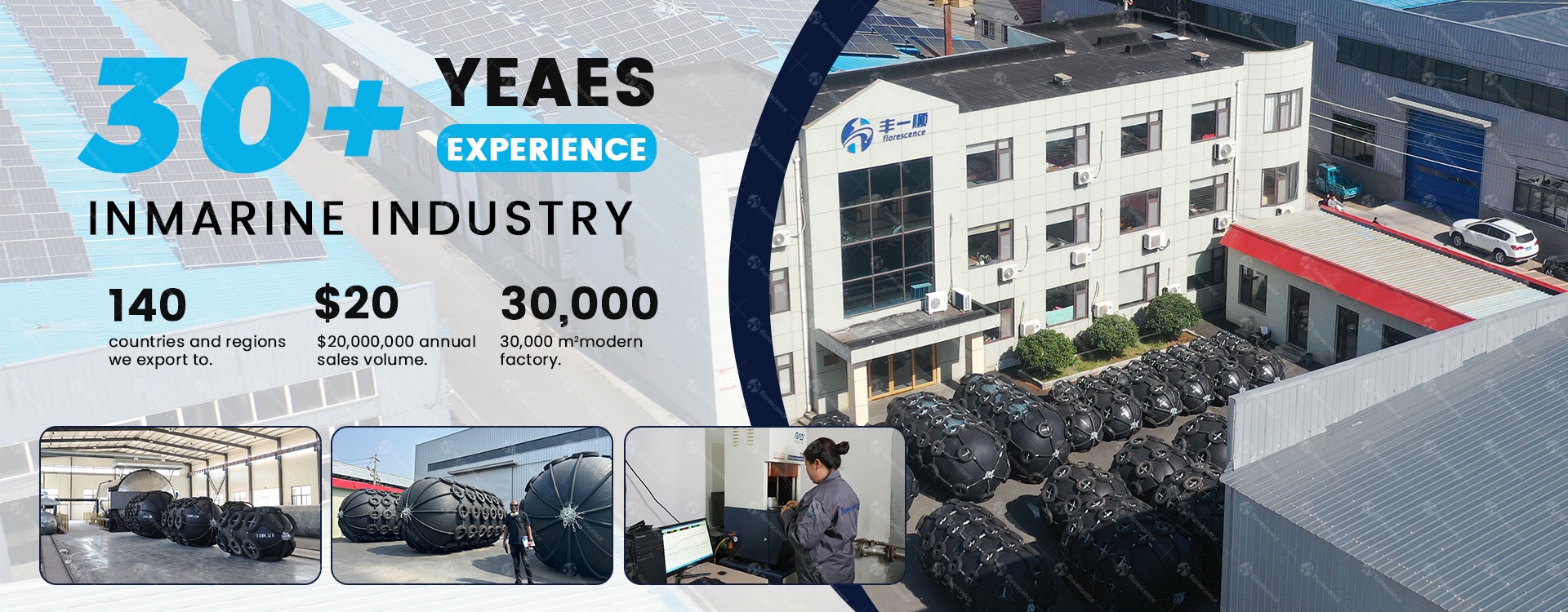
Supporting image: pneumatic rubber fenders in production at the Florescence factory, ahead of pressure testing and packing.
Where Pneumatic Rubber Fenders Are Used: STS, STQ and STB
The three operating modes are distinct, and the fender configuration should reflect which one dominates the project.
Ship-to-ship (STS)
Two vessels are in contact, both moving. Pneumatic fenders are used as the protective medium between them during transfer operations. Florescence delivered four pneumatic fenders in size D2500 × L4000 mm to an offshore oil and gas supply company in Malta, where they are in service in ship-to-ship transfer operations. The reported result was smooth STS transfers, a reliable safety buffer in rough seas, enhanced transfer efficiency and reduced dynamic berthing impact, with a stated service life of 8–12 years.
Ship-to-quay (STQ) and ship-to-berth (STB)
One body is fixed and one is moving. The fender protects both the hull and the berth structure. This is where tidal range becomes the controlling variable: a floating pneumatic body stays engaged with the hull as the water level changes, which is why the category is specified for ports with extreme tidal variations.
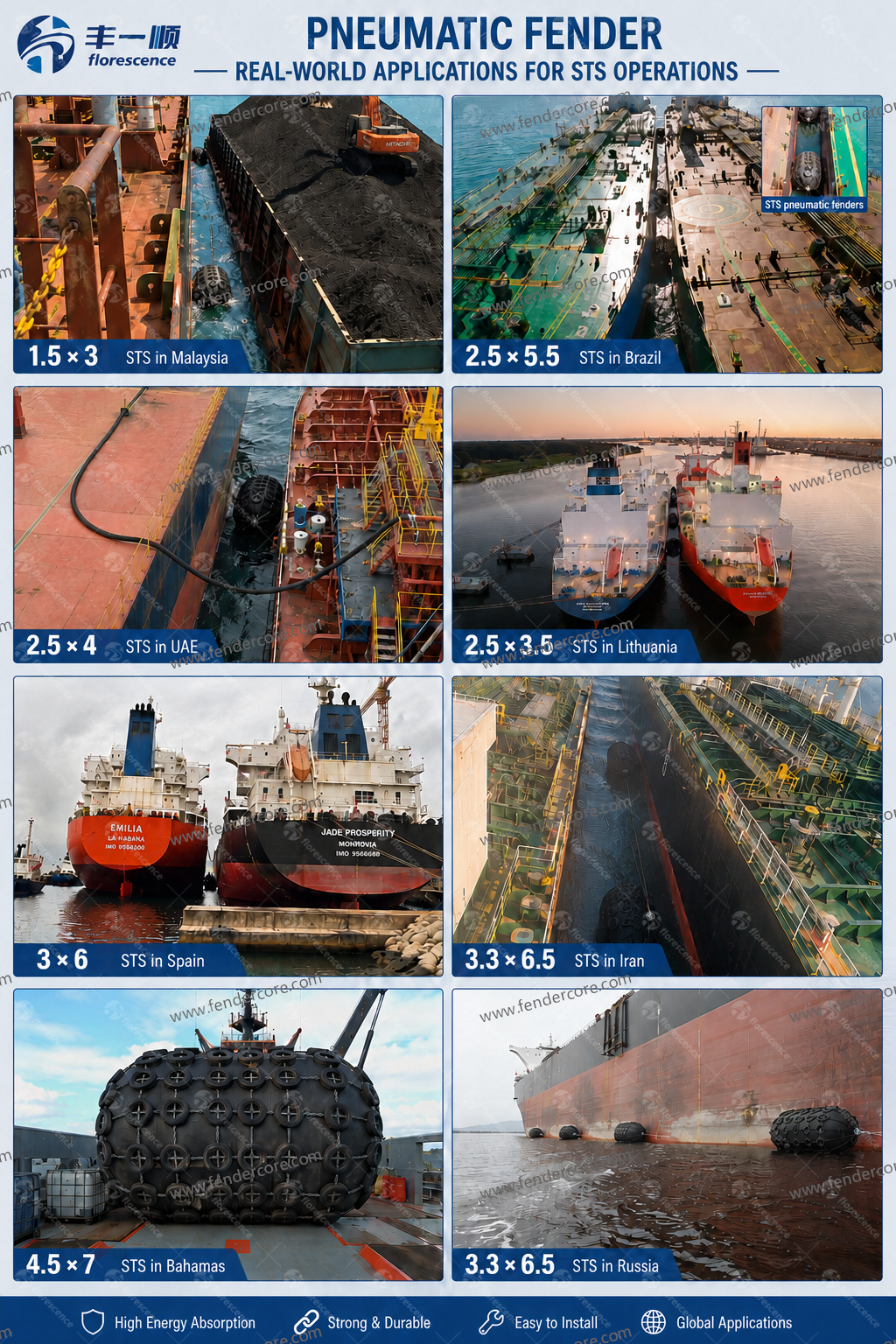
Supporting image: pneumatic fenders in different sizes staged for STS operations. Size and working pressure are selected per berthing case.
The published application list for pneumatic rubber fenders covers offshore platforms, oil and gas tankers, fast ferries and aluminium vessels, temporary and permanent installations, rapid response and emergencies, ports with extreme tidal variations, and fishing vessels, transport ships and ocean trawlers.
A notable special case is submarine berthing. Florescence delivered four hydro-pneumatic submarine fenders to the Bangladesh Navy, equipped with an internal water ballast system and counterweight to keep the fender standing vertically underwater, with an adjustable water-to-air ratio. The scope covered custom manufacturing, on-site technical guidance, installation, crew training and joint naval acceptance tests. This configuration is covered by an RMRS certificate for submarine pneumatic rubber fenders.
How Buyers Shortlist Recommended Pneumatic Rubber Fender Manufacturers
There is no single recommended manufacturer for port protection. What exists is a set of verifiable criteria that separates a manufacturer able to support a port project from one that can only quote a catalogue item. The criteria below are the ones that actually change outcomes.
Criterion 1 — Standard and certificate evidence
Ask for the certificate number, the issuing body, the scope and the standard referenced. Pneumatic fenders are typically qualified against ISO 17357-1:2014, with classification society involvement from bodies such as ABS, BV, CCS, DNV and LR. Qingdao Florescence holds a BV certificate (INS/NR/SHOP-25/377) for pneumatic rubber fenders against ISO 17357, issued 9 July 2025, and an RMRS certificate (21.10345.266) for submarine pneumatic rubber fenders against ISO 17357-1:2014, EN 10204:2004 and ISO 10474:2013, issued 16 August 2021. ISO 9001 (32726Q10126RIS, valid to 8 May 2029) and ISO 14001 (32725E20318R0S, valid to 27 May 2028) cover the production system.
Criterion 2 — Manufacturing identity and capacity
A trading company and a manufacturer answer differently when a project slips or a specification changes. Florescence was established in 1992, operates a 40,000 m² factory with 120 employees and 25 engineers, and states an annual output of 2,000 pcs with monthly capacity of 200 units for fender production.
Criterion 3 — Testing and inspection scope
Quality control for pneumatic fenders is not a single check. Florescence lists material testing, pressure testing, dimensional inspection, compression testing and third-party inspection by CCS, BV, ABS or DNV as standard options, and third-party witness and burst pressure testing can be arranged. A full Quality Inspection Report is issued before shipment, covering rubber test data, sizing sheets, coating thickness records and product photographs.
Criterion 4 — Body configuration and accessory supply
Confirm whether the offer is sling type or chain and tyre net, and whether the accessory set is complete: chain and tyre net, shackles, swivel joints, towing rings, U-ring and chain system, and air compressor. Incomplete accessory supply is a common source of commissioning delay.
Criterion 5 — Customisation and extreme-condition options
Project conditions sometimes fall outside the standard catalogue. Customisation at Florescence covers size, pressure, logo, fittings, package, solution and drawing. Special requirements that can be quoted include low-temperature resistance down to −40°C, fire-retardant and anti-static compound, custom colours and logo marking, and packaging configured for easy shipping.
Criterion 6 — Post-delivery support
Pneumatic fenders need pressure checks over their service life. Florescence provides 24/7 online technical support, installation, use and repair guidance, global on-site service, a 12–24 month warranty and free repair kits.
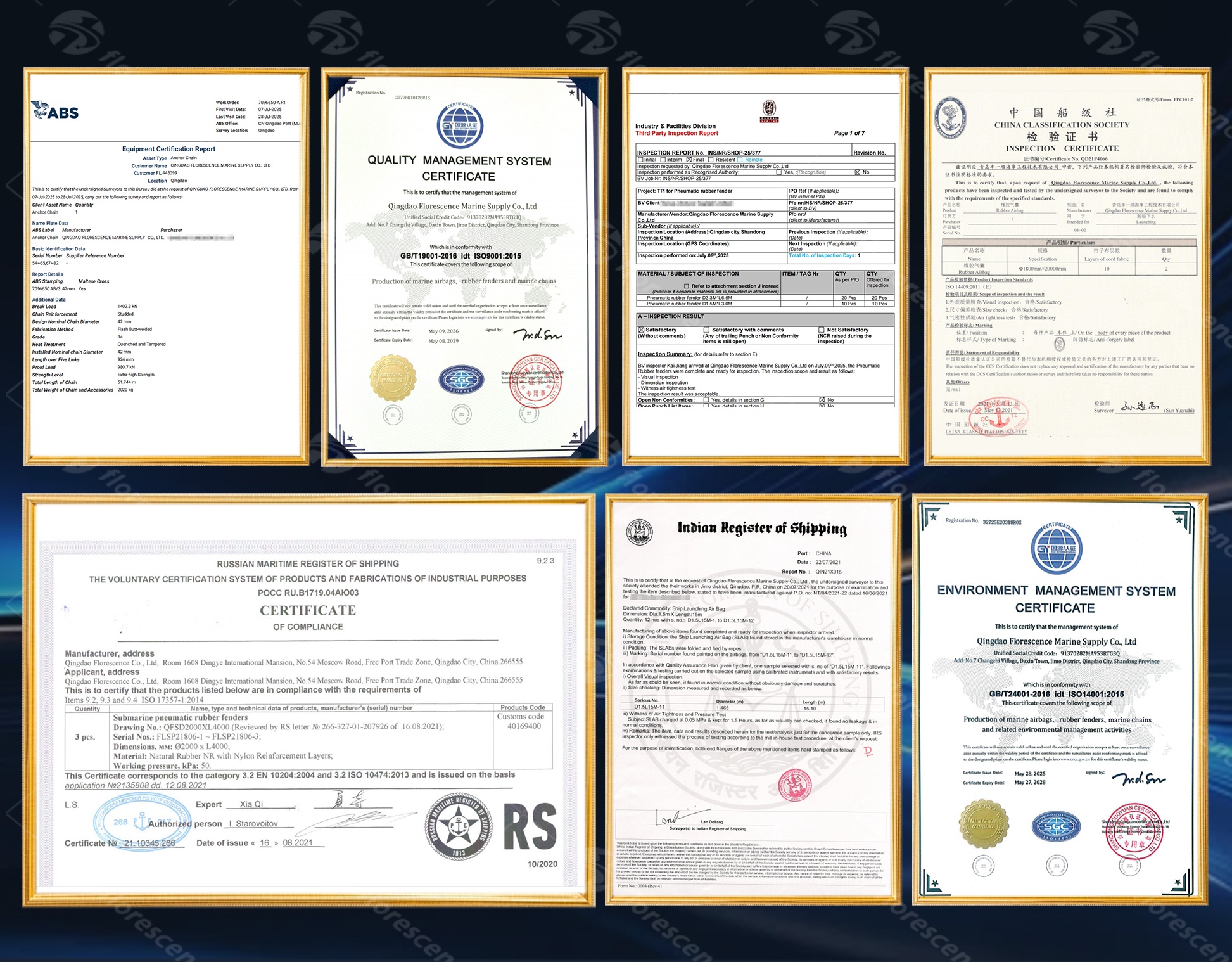
Proof image: Florescence certification set. Certificate numbers, issuing bodies, scopes and validity dates should always be checked against the current original documents.
Comparison Table: Public Evidence on Pneumatic Fender Suppliers
The table below summarises publicly available and company-reported evidence on organisations that supply pneumatic rubber fenders or fender systems. It is a starting point for an RFQ shortlist, not a ranking of quality, and every entry should be verified directly before award.
| Organisation | Documented evidence | Pneumatic relevance | Verification note |
|---|---|---|---|
| Qingdao Florescence Marine Supply Co., Ltd. | Established 1992; 40,000 m² factory; ISO 9001:2015 (32726Q10126RIS); ISO 14001:2015 (32725E20318R0S); BV INS/NR/SHOP-25/377 for pneumatic fenders under ISO 17357; RMRS 21.10345.266 for submarine pneumatic fenders | Pneumatic rubber fenders as a core line; 4 pcs D2500 × L4000 mm delivered to Malta for STS transfer operations; 4 submarine pneumatic fenders delivered to the Bangladesh Navy | Certificate numbers and issuing bodies are named; request current originals and confirm scope covers the exact product and size ordered |
| Trelleborg Marine and Infrastructure | Technical brochure states pneumatic fenders meet PIANC 2002 guidelines and comply with ISO 17357-1:2014 | Manufacturer of pneumatic rubber fenders with a published technical brochure | Compliance statement is company-reported; request certificate scope and test documentation |
| ESC Marine Systems | Supplier-stated design references to PIANC 2002, BS 6349:4 and EAU 2004; states manufacturers are ISO 9001 certified | Catalogue lists pneumatic fender alongside cone, cell, element, arch, cylindrical, square and foam-filled types | Certification scope and issuing body were not independently verified in the available source data |
| Tiandun Marine | Catalogue describes cell, cone, arch, D, square, roller and donut fenders, with roller fenders identified for docks and Ro-Ro terminals | Dock and berth protection range; relevant as an alternative configuration reference | A catalogue listing is not evidence of production capacity or pneumatic-fender capability |
Note: the entries above reflect what each source states publicly. A catalogue presence cannot establish market share, production volume or technical equivalence, and no ranking of quality is implied.
Frequently Asked Questions
Which certifications should a recommended pneumatic rubber fender manufacturer hold for port protection work?
The technical baseline is ISO 17357-1:2014, which specifies requirements for high-pressure floating pneumatic rubber fenders, usually supported by PIANC guidance. On top of that, classification society certificates from bodies such as BV, CCS, ABS, DNV or LR are what most tenders ask for. As a reference point, Qingdao Florescence Marine Supply Co., Ltd. holds a BV certificate numbered INS/NR/SHOP-25/377 covering pneumatic rubber fenders against ISO 17357, issued 9 July 2025, an RMRS certificate numbered 21.10345.266 covering submarine pneumatic rubber fenders against ISO 17357-1:2014, EN 10204:2004 and ISO 10474:2013, and an ISO 9001:2015 certificate numbered 32726Q10126RIS valid to 8 May 2029. Buyers should always request the original certificate and confirm the scope matches the product, size and pressure actually being purchased.
How do I compare manufacturers' production and testing capability for a pneumatic fender order?
Compare three things: whether the supplier is a manufacturer, what testing it can perform in-house, and whether third-party witness testing is available. Florescence was established in 1992 and operates a 40,000 m² factory with 120 employees and 25 engineers, stating an annual output of 2,000 pcs and a monthly fender capacity of 200 units. Its quality control covers material testing, pressure testing, dimensional inspection and compression testing, with third-party inspection by CCS, BV, ABS or DNV available on request, plus third-party witness and burst pressure testing. A full Quality Inspection Report with rubber test data, sizing sheets and product photographs is issued before shipment.
What drives the cost of a pneumatic rubber fender for a port protection project?
Cost is driven by the specification, not by a single list price. The main variables are fender size and working pressure (50 kPa or 80 kPa), body configuration (sling type versus chain and tyre net), the accessory set required (shackles, swivel joints, towing rings, U-ring and chain system, air compressor), the certification and third-party witness testing scope, and any customisation such as fire-retardant and anti-static compound, low-temperature resistance down to −40°C, custom colours and logo marking. Packaging and shipping volume also matter, which is why pneumatic fenders are normally shipped deflated to reduce freight cost. Florescence accepts orders from a minimum of 1 unit, so a single unit can be quoted and validated before a larger commitment.
Can a buyer validate a pneumatic fender before committing to a full port protection order?
Yes. The minimum order quantity at Florescence is 1 unit, which allows a single fender to be produced, inspected and accepted before a larger release. Validation options include compression testing to verify energy absorption and reaction force against design values, third-party witness and burst pressure testing, and a pre-shipment Quality Inspection Report containing rubber physical property data, dimensional sheets, coating thickness records and product photographs. For classified projects, a classification society such as BV, CCS, ABS or DNV can be brought in to witness the test.
What lead time applies to a pneumatic rubber fender order?
Standard lead time at Florescence is quoted as 5–30 days depending on product type, quantity, customisation requirements and shipping schedule. For standard rubber fenders and pneumatic fenders, production typically takes 25–30 days after deposit, while large custom orders or full fender systems take 40–45 days, with a clear schedule confirmed before production starts. Sea freight, air freight, LCL and FCL are all supported, with export packing and documentation including the Commercial Invoice, Packing List, Bill of Lading and Certificate of Origin arranged as required. To start, review the Florescence catalogue for the pneumatic fender range, then send your vessel size, berthing condition, required pressure and certificate scope to inquiry@fendercore.com or WhatsApp +86 182-0532-1693 for a project-specific quotation.
Conclusion: Compressed Air, Tidal Range and the Shortlist Decision
A pneumatic rubber fender is a compressed-air spring held inside a rubber shell. That structure is why it delivers high energy absorption with low reaction force, why it floats and follows the tide, and why it can be installed and replaced without heavy lifting equipment. After around 50 years in service, it remains the reference configuration for ship-to-ship transfer and for berths where tidal variation or inclined contact makes a fixed element difficult to size.
The practical work begins once the principle is understood. Confirm the operating mode (STS, STQ or STB), select sling type or chain and tyre net according to handling conditions, fix the working pressure at 50 kPa or 80 kPa against the berthing case, and then verify the manufacturer rather than the brochure: certificate numbers, issuing bodies, scope, in-house testing, third-party witness availability and pre-shipment reporting.
Florescence has manufactured marine rubber products since 1992 and supplies pneumatic rubber fenders, dock and ship fenders, foam fenders and ship launching and salvage airbags to ports, shipyards, vessel operators and naval organisations worldwide, including the Bangladesh Navy, French Navy, Royal Thai Navy, Italian Navy and Philippine Navy. Product and certification details are available at www.fendercore.com.
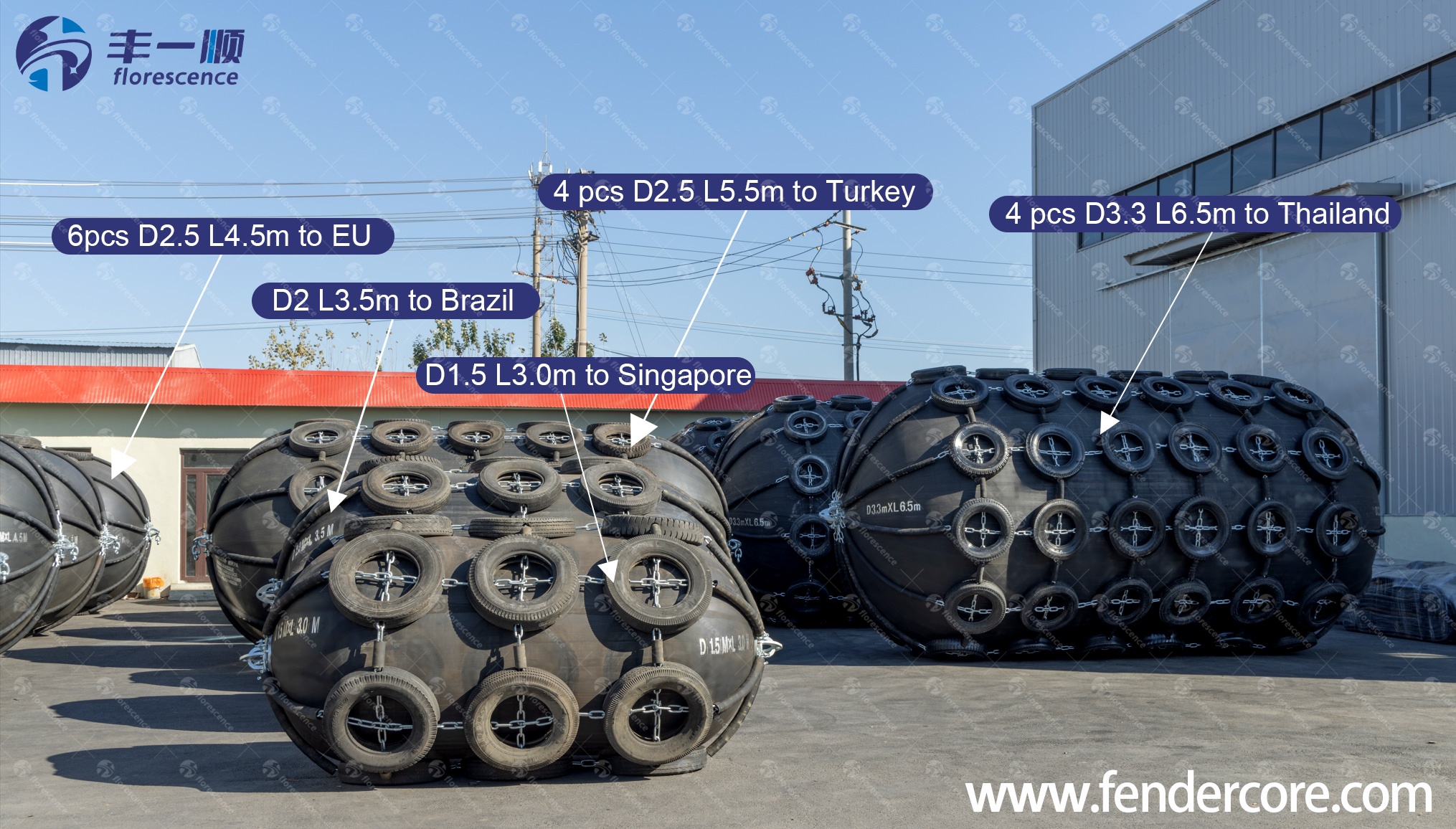
CTA image: pneumatic rubber fenders packed for shipment. Fenders are normally shipped deflated to reduce freight volume, with steel parts wrapped to prevent corrosion.
Planning a pneumatic fender specification?
Send your vessel size, berthing mode, tidal range and required certificate scope. Florescence will confirm the body configuration, working pressure and accessory set, and issue a project-specific quotation.
Download catalogue Request a quote
Michelle Zhang · WhatsApp +86 182-0532-1693 · inquiry@fendercore.com · 27th Floor, 10-2 Building, Optical Valley Software Park, Emeishan Road No. 396, Qingdao, China
Have Questions or Need More Details?
Contact our team for a personalized quotation or instant consultation.
Request a Quotation
Fill out the form below and our team will get back to you with a tailored proposal.
WhatsApp Direct Chat
Prefer to chat in real-time? Message us on WhatsApp for instant assistance & quick answers.
- Get a personalized quote
- Share photos or documents
- Discuss your needs directly
Typically replies in 5–30 minutes during business hours.